
The moment AI search got its own Search Console
For two years, marketers have been asking the same question: "Are we showing up in ChatGPT, and does it matter?"
Until now, every answer came from the outside. Teams ran prompts manually, used third-party trackers, and estimated AI's effect by looking at referral traffic in analytics.
On 10 November 2026, OpenAI changed that. As part of its Businesses in ChatGPT beta, it launched Business Hub, a free management layer that lets companies:
- Claim and verify their business profile. This covers the name, logo, description (up to 300 characters), product feed, and delivery and return details.
- View performance insights. These are mentions, website clicks and top discovery topics, over 7- or 28-day windows.
- Set up a Business Agent. This is a branded agent that answers customers inside ChatGPT. It's currently limited to eligible US ecommerce and online service businesses.
Note: Business Hub is not the same as the paid ChatGPT Business team plan. Same word, different product.
This matters. When a platform publishes its own visibility metrics, the category becomes real. AI visibility has moved from "interesting experiment" to a number your CMO will ask about every week.
That is exactly why the definitions matter.
The fine print: what OpenAI counts as a "mention"
In the GEO and AEO world, a mention usually means your brand was named in an AI answer.
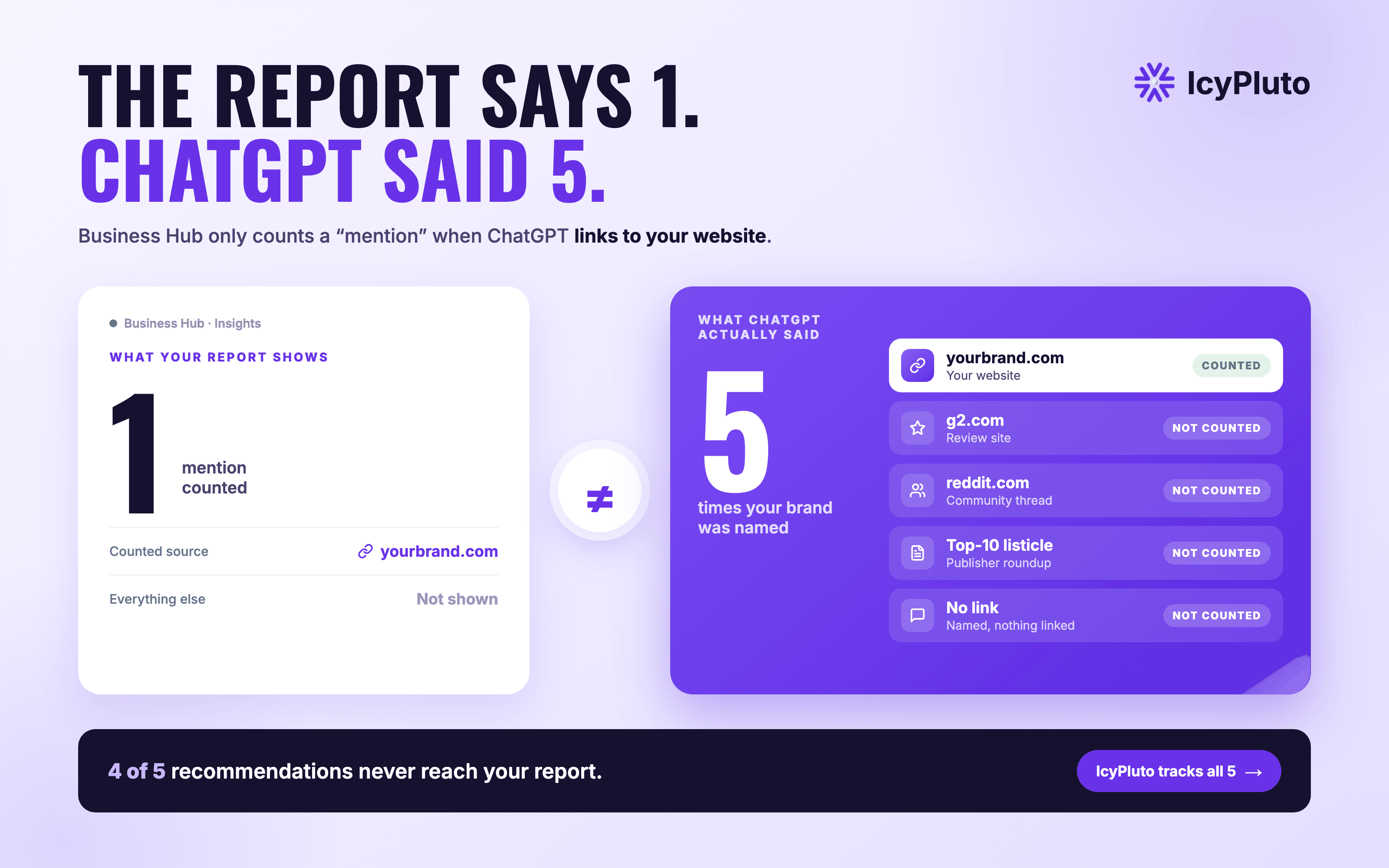
Business Hub uses a different rule:
| Business type | When Business Hub counts a "mention" |
|---|---|
| Online business | ChatGPT references your website in a response |
| Local business | ChatGPT surfaces a result for your location |
| Brand named, but linked elsewhere | Not counted |
In other words, Business Hub measures owned-domain citations, not brand mentions.
Here is why that distinction is important:
- Most AI recommendations cite third-party sources. Review platforms, comparison listicles, community threads and publisher roundups often do the heavy lifting. ChatGPT may recommend you by name and still give your site no credit.
- Strong earned-media brands will look weaker than they are. If your PR, reviews and community presence are excellent, Business Hub will undercount you.
- Comparisons between teams break down. When marketing reports "mentions" from one tool and the SEO team reports them from Business Hub, the two teams are measuring different things under the same name.
Rule of thumb: treat Business Hub "mentions" as "owned citations" in every internal report.
Clicks and topics: useful, but read them carefully
Clicks are clicks on links inside ChatGPT. They are not confirmed sessions, sign-ups or purchases. Expect a gap between Business Hub clicks and what your analytics records, because of redirects, privacy settings and bounces before load.
Discovery topics are aggregated themes, not raw prompts. Low-volume topics may be hidden entirely. They are great for spotting direction, but not for building a prompt-level content plan.
Expect a low click-through rate as well. AI answers are designed to resolve intent inside the conversation. A small CTR doesn't mean the channel is failing. It means the answer itself has become the storefront, and being cited in it matters even when nobody clicks.
What Business Hub doesn't tell you
The dashboard is a strong starting point, but it is a narrow window. It does not show:
- Prompt-level visibility. You can't see which specific questions you win or lose.
- Unlinked brand mentions. You can't see when you're recommended without a link to your domain.
- Competitor share of voice. You can't see who appears alongside you, or instead of you.
- Sentiment and positioning. You can't see whether you're described as "premium", "budget", "outdated" or "best for teams".
- Third-party sources. You can't see which external pages are shaping ChatGPT's view of your brand.
- Other AI engines. You can't see Google AI Overviews and AI Mode, Gemini, Perplexity, Copilot or Claude.
- Business impact. You can't see what happens after the click.
It also has a clear ecommerce and B2C bias. Product feeds, delivery and returns, and the Business Agent are built for transactional brands. B2B, SaaS and service companies should still claim their profile, but they will get less out of it today.
The IcyPluto AI Visibility Scorecard: four layers, one view
To make Business Hub data useful, put it inside a wider measurement framework. At IcyPluto, we recommend tracking AI visibility in four layers:
| Layer | Question it answers | Key metric | Source |
|---|---|---|---|
| Named | Does AI mention us at all? | Brand mention rate across a defined prompt set | AI visibility tracking |
| Cited | Does AI point to our domain? | Owned citations (Business Hub "mentions") | Business Hub + tracking |
| Clicked | Do users act on it? | Clicks, owned-citation CTR | Business Hub + analytics |
| Converted | Does it drive revenue? | AI-referred sessions → leads, pipeline, sales | Analytics + CRM |
Business Hub covers Layers 2 and 3 for one engine. Layers 1 and 4, plus every other AI platform, are up to you.
Two ratios are worth watching:
- Citation Capture Rate = Owned citations ÷ Total brand mentions. How often does AI credit your site when it talks about you? A low rate means third-party pages are shaping your story. That should prompt work on your own content, and outreach to the sources that are being cited.
- Citation-to-Click Rate = Clicks ÷ Owned citations. When AI cites you, is the cited page worth the click? A weak rate often means the wrong URL is being cited, such as an old blog post instead of a product page.
Your 7-day action plan
Day 1: Claim and verify. Claim your ChatGPT business profile, complete verification, and fill in every field. Write the 300-character description like a positioning statement, not a tagline.
Day 2: Record your baseline. Export your first 7-day and 28-day mentions, clicks and topics. Calculate your owned-citation CTR. That number is your starting line.
Day 3: Fix your vocabulary. Agree on definitions across marketing, SEO and leadership for mention, citation, click and visit. Put them in your reporting template.
Day 4: Map the cited URLs. Find out which of your pages ChatGPT is actually citing. Make sure those pages are current, well structured and conversion-ready.
Day 5: Build your prompt set. List the 30–50 questions your buyers really ask, covering category, comparison, problem and use-case questions. This is the foundation for Layer 1 tracking.
Day 6: Audit third-party sources. Identify the review sites, listicles and communities that AI cites in your category. These are now AI distribution channels, so treat them that way.
Day 7: Set up weekly reporting. Put all four layers in one dashboard and review it every week, alongside SEO and paid.
The bigger picture
Business Hub signals three shifts that will shape marketing in 2027:
- AI visibility is now an official KPI. When the platform reports it, the boardroom will too.
- Owned content and earned media are converging. You need ChatGPT to cite your domain and trust the sources that talk about you.
- Measurement will stay fragmented. Every AI engine will define "visibility" differently. The brands that win will have one source of truth across all of them.
Search Console didn't replace SEO strategy; it made SEO measurable. Business Hub will do the same for AI search, but only for the teams that read the numbers correctly.
FAQ
Is ChatGPT Business Hub free? Yes, during the current beta. OpenAI hasn't committed to keeping it free permanently.
Does claiming my profile improve my rankings in ChatGPT? No, according to OpenAI. Claiming gives you control over your profile and access to insights. It doesn't directly increase how often ChatGPT recommends you.
Should B2B companies claim their profile? Yes. The commerce features are less relevant, but the owned-citation and click data is still useful first-party signal.
Why are my Business Hub mentions lower than my AI tracking tool shows? Because Business Hub only counts references to your website. Brand mentions that link to third-party sites aren't included.
Does Business Hub track Google AI Overviews, Gemini or Perplexity? No. It only covers ChatGPT.
See the full picture with IcyPluto. Business Hub tells you how often ChatGPT cites your site. IcyPluto shows you where you're mentioned, who you're competing with, how you're described, and what to fix, across every major AI engine.