
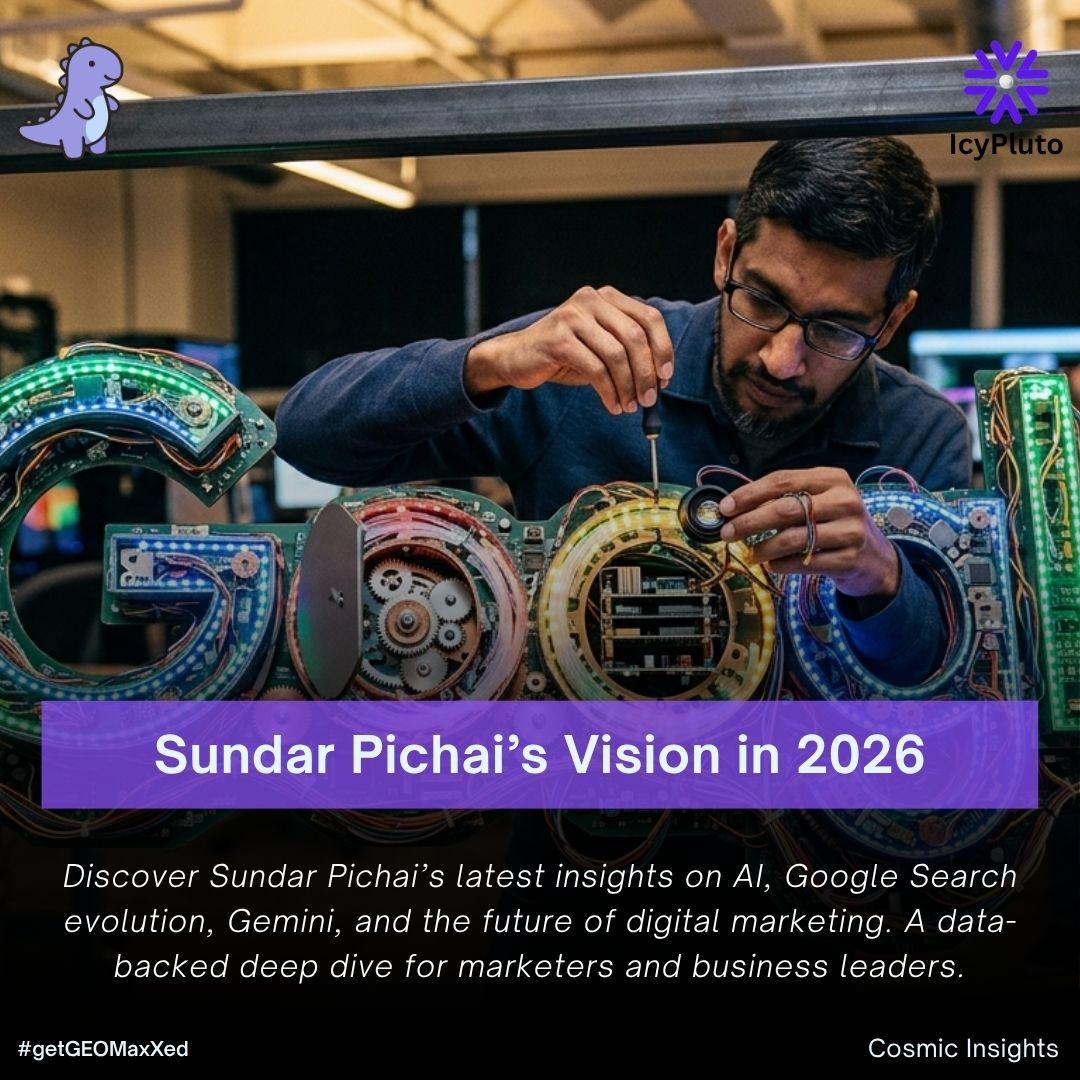
Sundar Pichai’s Vision in 2026: AI, Search, and the Reinvention of the Internet
In 2026, the conversation around artificial intelligence is no longer about if it will transform industries—it’s about who will control the transformation. And at the center of that shift sits Sundar Pichai, steering Google through its most consequential evolution since the launch of Search.
Pichai’s recent interviews, keynote speeches, and earnings calls reveal a clear thesis: AI is not a feature—it is the new interface of the internet.
And if you’re in marketing, SEO, or business strategy, this isn’t just interesting—it’s existential.
The Big Shift: From Search Engine to Answer Engine
For over two decades, Google dominated with a simple premise: organize the world’s information. But Pichai has made it clear that this mission is evolving.
Today, Google is shifting from link-based discovery to AI-generated answers.
This is not subtle. It’s structural.
According to Google’s internal data shared during recent events:
Over 60% of search queries now end without a click
AI-powered search features (like SGE) have increased query satisfaction by 30%+
Users interacting with AI summaries spend 2x more time within Google’s ecosystem
This signals a massive change:
Google is no longer sending traffic—it’s absorbing it.
Pichai himself emphasized that the future of Search is “multimodal, conversational, and predictive.” That means text, voice, image, and video inputs all converging into one AI layer.
This shift directly impacts SEO. Ranking #1 is no longer enough—being cited by AI is the new visibility.
Gemini and the AI Arms Race
At the heart of Pichai’s strategy is Google Gemini, Google’s flagship AI model designed to compete with systems like GPT-4.
But here’s where Pichai’s insight gets interesting:
He doesn’t position Gemini as just a chatbot competitor. He frames it as an infrastructure layer across all Google products.
And the scale is staggering:
Gemini is integrated into 15+ Google products including Gmail, Docs, Android, and Search
Google reports 1.5 billion users interacting with AI features monthly
AI Overviews (SGE) are now live in over 120 countries
This is not a product rollout. This is platform-level dominance.
Pichai’s strategy is clear:
Instead of building a single AI destination, Google is embedding AI into every user touchpoint.
This is fundamentally different from competitors. While others build tools, Google is rebuilding the internet interface itself.
The Death of Traditional SEO (And What Replaces It)
Pichai hasn’t explicitly said “SEO is dead”-but his actions suggest something close.
The old SEO playbook was built on:
Keywords
Backlinks
Rankings
But AI-driven search prioritizes:
Context
Authority
Entity relationships
Real-world credibility
Data backs this shift:
Pages with strong topical authority are 3x more likely to be cited in AI answers
Long-form, expert-driven content sees 40% higher inclusion rates in AI summaries
Brand mentions (even without links) are becoming ranking signals
This means we are entering the era of:
Generative Engine Optimization (GEO)
Pichai’s subtle but powerful message:
“The best content will be the most useful content—not the most optimized.”
That changes everything.
Multimodal Search: The Next Interface War
Another major insight from Pichai is the rise of multimodal search.
With tools like Google Lens and Gemini, users can now:
Take a photo and ask questions
Speak queries conversationally
Combine text + image inputs
Google reports:
Over 20 billion visual searches per month
Lens usage has grown 4x in the last two years
Multimodal queries are increasing at double-digit rates YoY
This is critical because it changes how users express intent.
Instead of typing “best running shoes,” users now:
→ Snap a photo and ask: “What are these and are they good?”
This reduces reliance on traditional keywords and increases reliance on contextual understanding.
For marketers, this means:
Your content must be optimized not just for text—but for visual and conversational discovery.
AI + Ads: Google’s $200 Billion Question
Let’s address the elephant in the room:
Google makes over 80% of its revenue from advertising.
So how does AI—which reduces clicks—fit into that model?
Pichai’s answer is nuanced.
He’s betting on AI-enhanced ads, not fewer ads.
Recent data shows:
AI-powered ad campaigns deliver 20-30% higher conversion rates
Automated bidding driven by AI improves ROI by 15%+
Performance Max campaigns now account for a growing share of ad spend globally
Instead of users clicking links, ads are becoming:
Conversational
Context-aware
Embedded within AI responses
This means ads are shifting from interruption-based to intent-integrated.
Pichai isn’t worried about losing ad revenue.
He’s redesigning how monetization works in an AI-first world.
The Rise of “Zero Interface” Computing
One of Pichai’s most underrated insights is the concept of ambient computing.
He envisions a world where:
You don’t “search”-you ask
You don’t “open apps”-they respond proactively
AI anticipates needs before queries are made
This aligns with trends already visible:
Voice assistants handling 25%+ of mobile queries in some regions
Predictive suggestions driving significant engagement increases
Wearables and IoT devices integrating AI into daily life
This is what can be called zero interface computing.
The implication?
Search becomes invisible—but more powerful.
Trust, Regulation, and the AI Responsibility Debate
Pichai has repeatedly emphasized responsible AI development.
And this is not just PR.
With regulators across the US, EU, and India tightening AI policies, Google faces real pressure.
Key concerns include:
AI hallucinations
Bias in training data
Content attribution
Copyright issues
Recent studies show:
Nearly 52% of users are concerned about AI misinformation
Trust in AI-generated content is still below 60% globally
Pichai’s approach focuses on:
Transparency in AI outputs
Clear labeling of generated content
Collaboration with governments
But here’s the deeper insight:
Trust will become the ultimate ranking factor.
Not just for Google—but for brands.
What This Means for Marketers and Businesses
If you strip away the noise, Pichai’s insights point to five clear strategic shifts:
1. Authority > Keywords
Brands that demonstrate expertise will dominate AI visibility.
2. Content Depth Wins
Thin content is disappearing. Long-form, insight-rich content performs better.
3. Brand Mentions Matter
Unlinked mentions are becoming signals of credibility.
4. AI Visibility Is the New SEO
You’re not optimizing for rankings—you’re optimizing for inclusion in answers.
5. Experience Is the New Click
User engagement within platforms matters more than traffic volume.
A Contrarian Insight: Google Is Becoming the Internet
Here’s the uncomfortable truth most marketers aren’t ready to accept:
Google is no longer just a gateway to the internet.
It is becoming the internet.
With:
AI answers
Integrated tools
Embedded transactions
Users have fewer reasons to leave Google’s ecosystem.
This creates a paradox:
The better Google gets, the less traffic you get.
And that means your strategy must evolve from:
→ “How do I get traffic?”
to
→ “How do I stay visible inside AI ecosystems?”
That’s the real game.
Conclusion: The Pichai Playbook for the Future
Sundar Pichai’s latest insights aren’t predictions—they’re already unfolding realities.
AI is reshaping:
Search
Advertising
Content
User behavior
And the winners will not be those who adapt slowly.
They will be those who understand that:
Visibility is no longer about ranking—it’s about relevance within AI systems.