
Introduction
AI search has changed what “visibility” means. Instead of only competing for blue links, brands now compete for inclusion inside AI-generated responses, where citation frequency can shape authority, trust, and demand. That means the brands that earn citations earlier often gain an outsized advantage in category discovery.
Citation seeding is the strategy of intentionally creating content, entities, and supporting signals that AI systems can recognize and cite. It is not about gaming the system. It is about making your brand easier to understand, easier to trust, and easier to surface in AI-powered responses AI real buyer questions. For IcyPluto, this is a natural extension of its GEO and citation-focused approach.
What Citation Seeding Means
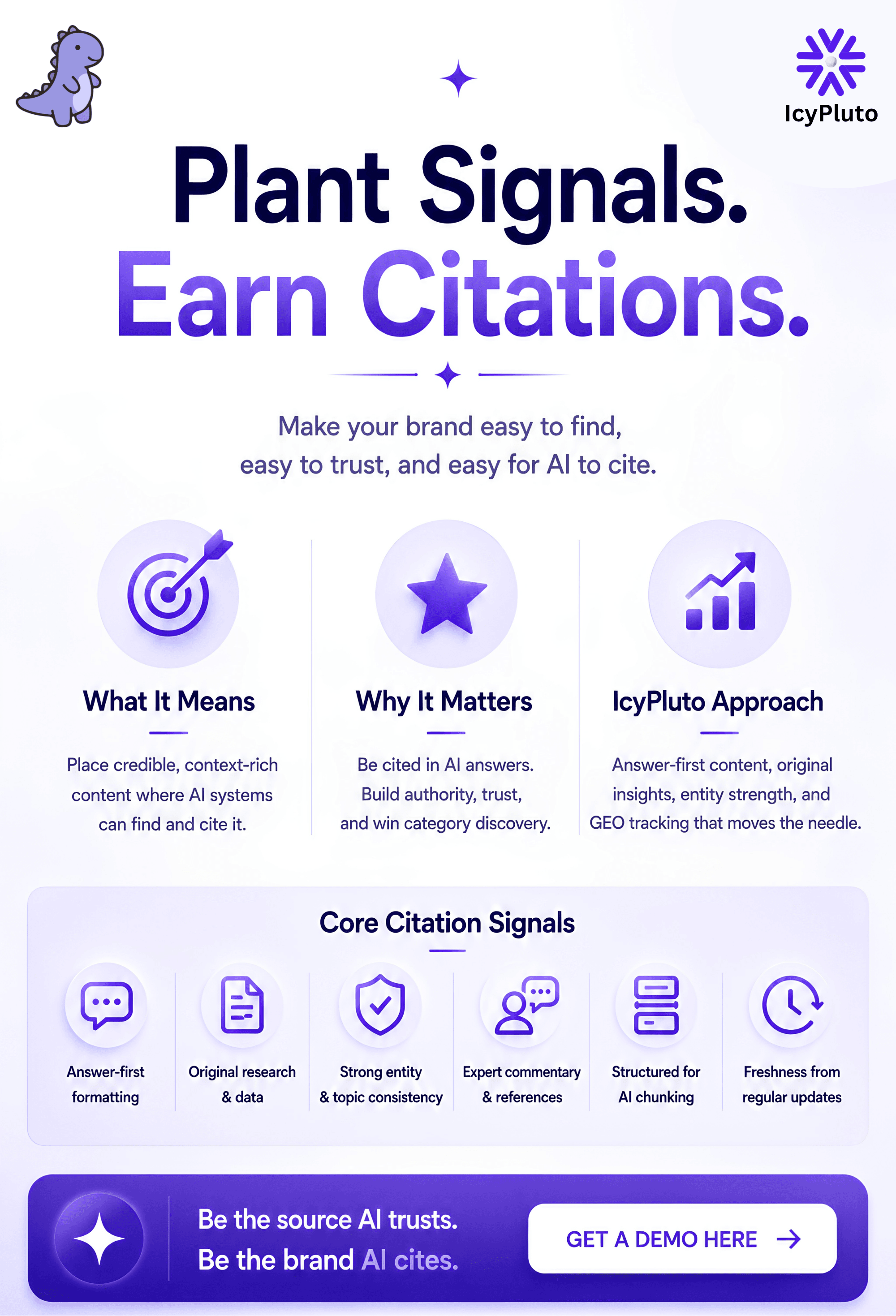
Citation seeding is the process of placing strong, credible, and context-rich content where AI systems are likely to encounter and reference it. This can include original research, structured blog content, clear answer blocks, expert quotes, and supporting references that reinforce topical authority. In practice, it helps generate signals that increase the likelihood of being cited in AI answers.[icypluto]
IcyPluto aligns with this approach by focusing on content designed for LLM chunking, Q&A scaffolding, and factual clarity. Its content strategy emphasizes direct answers, evidence blocks, and takeaway-driven structure so AI systems can parse the information more easily. That structure makes the content more useful to both humans and machines.
Why It Matters
Citation seeding matters because AI systems do not cite randomly. They tend to favor content that is clear, structured, and supported by signals of authority. That means brands that publish generic content may still be ignored, while brands with deliberately citation-friendly content may be surfaced more often.
This is especially important in competitive categories where buyers rely on AI answers to compare options. If your brand is not present in those answers, you may lose the opportunity before the user ever reaches your site. Citation seeding gives you a better chance of appearing earlier in that decision path.
How IcyPluto Approaches It
IcyPluto’s approach to citation seeding is built around creating content that earns visibility naturally. The platform uses baseline GEO visibility tracking, AI-sourced traffic monitoring, entity salience tracking, and original research to improve the odds of external mentions and citations. That makes it more than a content tool — it becomes a visibility system.
The process is also practical. IcyPluto structures content around specific questions, uses consistent answer blocks, and supports original data and SME quotes that make the page more reference-worthy. When a brand publishes this kind of content consistently, it becomes easier for AI models to recognize it as a credible source.
Core Citation Signals
AI citation performance usually improves when a page has a few clear properties. The strongest ones are clarity, topical focus, original insights, and easily extractable structure. IcyPluto’s framework is built to reinforce these exact qualities.
Some of the most effective citation signals include:
Direct answer-first formatting.
Original research or first-party data.
Strong entity and topic consistency.
Expert commentary and credible references.
Section-based structure that supports AI chunking.
Freshness signals from regular updates.
These are not just good writing habits. They are visibility signals that help AI systems decide what content is worth referencing.
Table: Citation Seeding Workflow
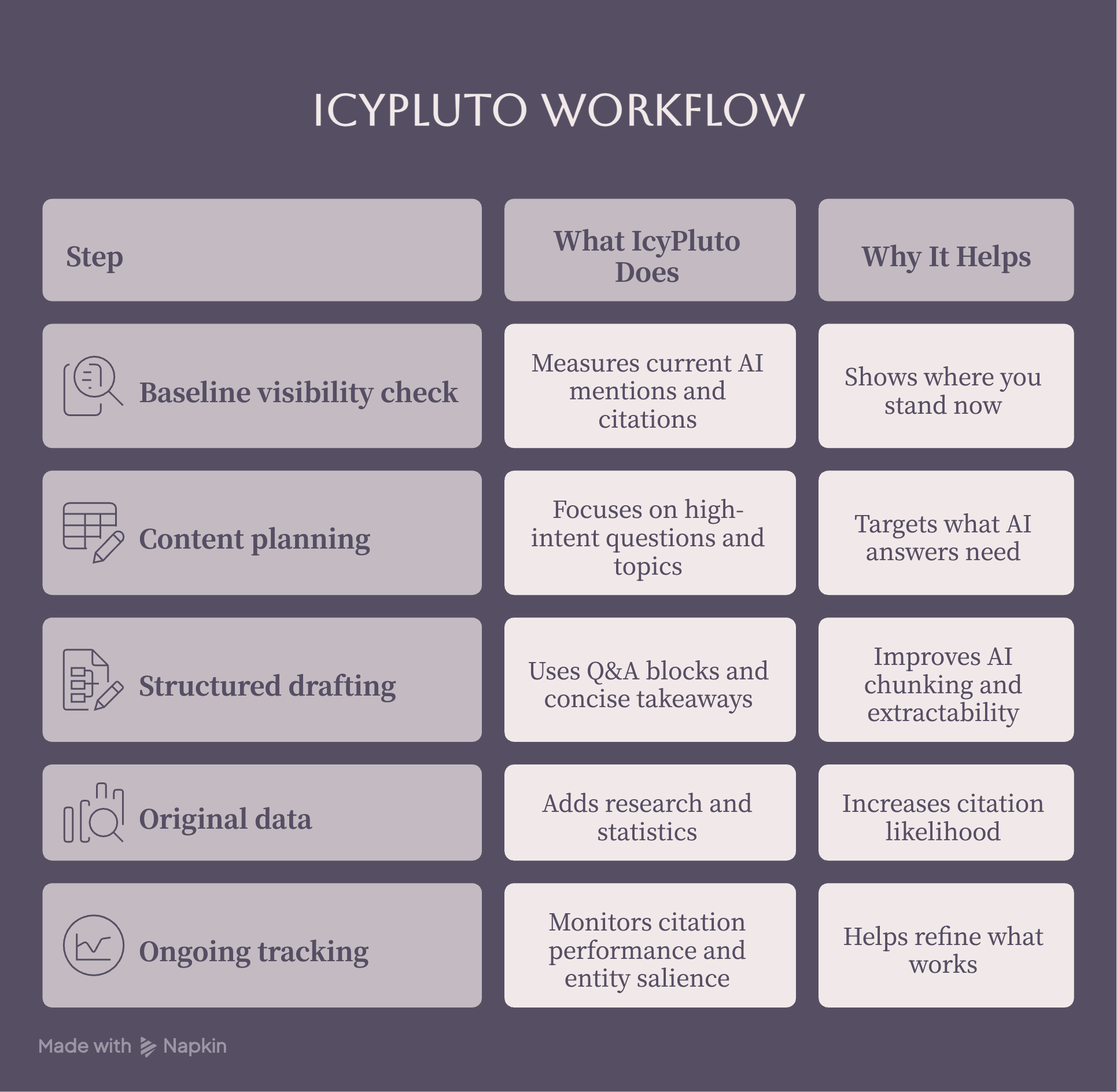
This workflow makes citation seeding measurable instead of theoretical. That is important because brands need to know whether the content they publish is actually influencing AI visibility.
IcyPluto Feature Advantage
IcyPluto’s advantage is its ability to connect content creation with visibility tracking. Instead of writing content and hoping it gets noticed, the platform helps brands build from baseline to citation to iteration. That creates a more complete system for AI search growth.
It also helps brands avoid the common mistake of treating AI visibility as a one-off content task. Citation seeding works best when it is part of an ongoing strategy that includes content updates, topic expansion, and performance review. IcyPluto’s framework is designed for that kind of repeatable execution.
Common Mistakes
Many brands fail at citation seeding because they prioritize volume over precision. Publishing more content is not enough if the content is generic, poorly structured, or disconnected from the questions AI users are asking. AI systems need context, not just copy.
Other common mistakes include:
Writing broad content with no clear point.
Ignoring original data and expert signals.
Failing to structure content for extraction.
Treating citations as a lucky outcome rather than a strategy.
Not tracking whether visibility improves over time.
These mistakes reduce the chances of being cited and make it harder to learn what is actually driving performance.
Conclusion
Citation seeding is one of the most practical ways to grow AI visibility today. It helps brands create the content and supporting signals that make AI systems more likely to cite them in answers. For IcyPluto, this is not just a tactic — it is part of a larger system for GEO, citation growth, and AI-driven marketing execution.
Brands that want to win in AI search need to stop thinking only about rankings. They need to think about how to become the source AI trusts, references, and reuses. That is where IcyPluto’s content strategy and citation-first approach create a real competitive advantage.