
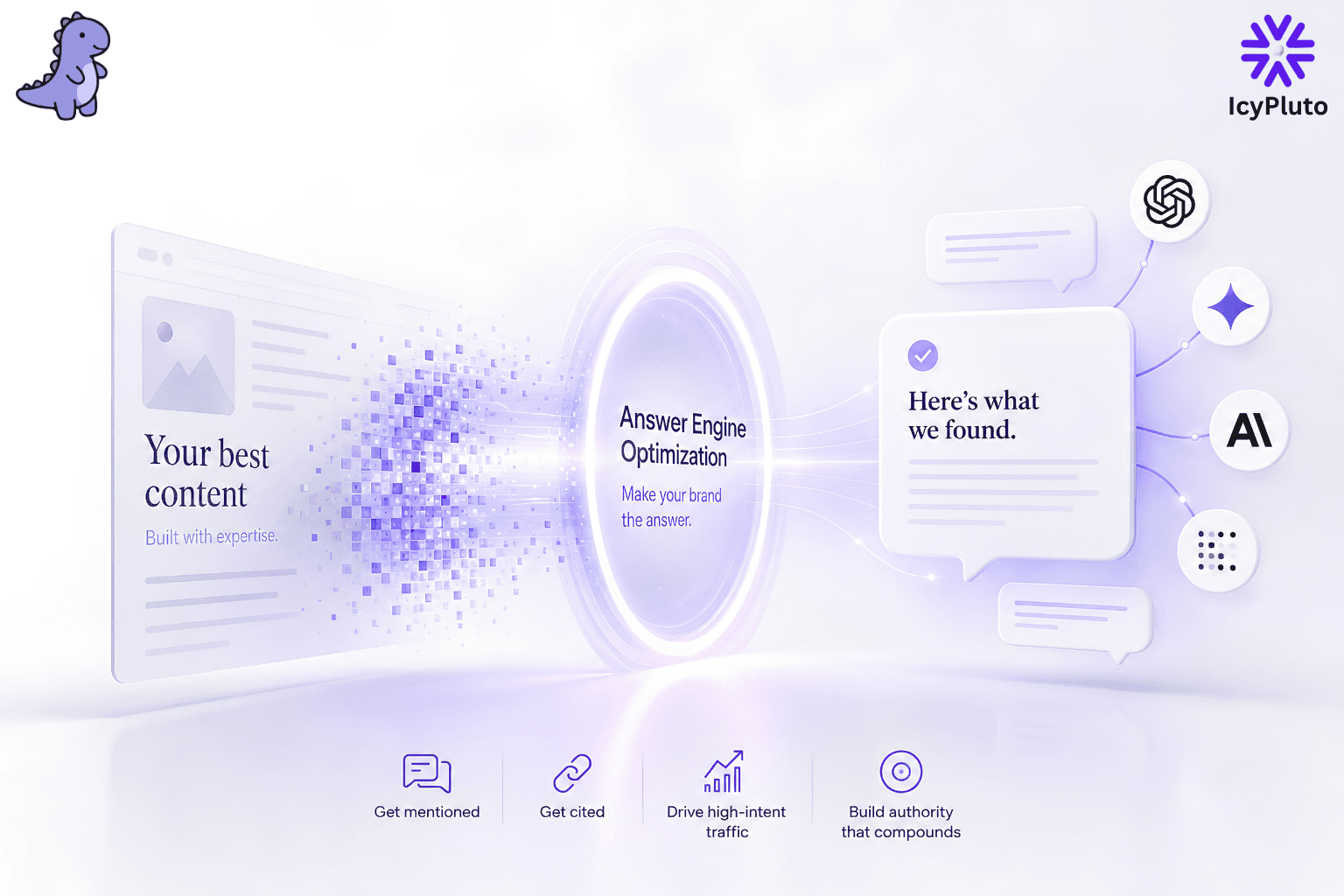
Answer Engine Optimization (AEO) is no longer theory. It is where AI visibility, pipeline, and brand authority now intersect.
Recent data show how quickly this is changing: 65% of Google searches end without a click, AI Overviews can cut organic CTR by 61%, and AI referral traffic converts at 4.4× the rate of traditional organic in some studies. At the same time, brands that appear on four or more external platforms are nearly three times more likely to be included in ChatGPT answers. In that world, getting cited and staying visible in AI answers is not a nice-to-have. It is the new baseline for discoverability.
This is exactly what an AEO playbook is built to solve. At its core, AEO has three jobs. First, make every important page extractable: answer-first blocks of 100–130 words, question-shaped headings, dated statistics, and named sources that LLMs can lift cleanly. Second, make your brand entity consistent and marked up: a canonical description everywhere, reinforced with Organization, Article, FAQPage, and Person schema so AI systems can recognize and trust your signals. Third, build off-site authority: podcasts, directories, reviews, forums, and unlinked mentions that create the “ambient reputation” AI uses to validate you.
For most companies, the gap is not owning enough content. It is owning the right kind of content in the right places, structured in ways AI can confidently reuse. Traditional SEO playbooks stopped at rankings and clicks. AEO adds the layer of citations, recommendations, and answer presence across engines.
What AEO Actually Optimizes For
AEO does not replace SEO. It extends it. Instead of optimizing only for SERP placement, AEO optimizes for four specific outcomes:
Mention Rate: how often your brand name appears inside AI-generated answers.
Citation Rate: how frequently your website is linked or referenced as a source.
Prompt Visibility: how many high-intent questions surface your brand across engines.
AI Referral Performance: how visitors arriving from AI interfaces convert compared with other channels.
The reason this matters is simple. As AI interfaces handle more research queries, discoverability is happening inside answers rather than only on results pages. If you are not being mentioned or cited, you are absent from the conversation before a buyer ever reaches your site.
The Core Steps Of AEO
Across multiple 2026 guides and operator playbooks, the AEO steps are strikingly consistent.
1. Make pages extractable
Every key page needs an answer-ready structure:
Open with a 100–130 word answer block that fully answers the main question.
Write every H2 as a question your buyer would type.
Use short, clean paragraphs and explicit definitions.
Back claims with named, dated statistics and clear prices or ranges.
This answer-first approach alone can drive a 30–40% lift in citation likelihood because models can copy a ready-made block instead of stitching answers from scattered phrases.
2. Align and mark up your entity
AI systems depend on entities. Your brand is one.
Use a canonical description of who you are and what you do across your site, LinkedIn, directories, and bios.
Avoid creative rephrasing for core facts like name, sector, and product lines.
Implement schema for Organization, Article/BlogPosting, FAQPage, Person, and Product/Service on key pages.
Consistent entities make you easier to match against queries and reduce conflicting information that can lower retrieval confidence.
3. Enable AI crawlers and llms.txt
If AI crawlers cannot read your content cleanly, you will not be cited.
Check
robots.txtto verify you are not blocking GPTBot, ClaudeBot, PerplexityBot, and similar agents.Create a llms.txt file listing your key content and clean Markdown versions stripped of navigation, ads, and scripts.
This gives models direct pointers to high-value material and reduces noise in what they ingest.
4. Build off-site authority
LLMs verify brand truth against human conversations. Off-site signals matter.
Pitch podcasts, write guest posts, and participate in industry webinars.
Claim and correct directory listings, review profiles, and marketplace entries.
Answer relevant community threads and publish quotable frameworks others adopt.
Unlinked mentions count. Models do not need a hyperlink to see repeated references to your brand, product, or executives.
5. Measure and iterate
AEO is not a one-shot project. It is an operating system.
Audit top 20 pages for answer blocks, structure, schema, and citations.
Track which prompts and engines cite you weekly.
Refresh key content quarterly with updated data and examples.
Over time, you build a flywheel where improved structure and authority lead to more citations, which drive more branded search and direct visits, which reinforce your signals.
How IcyPluto Turns AEO Into A System, Not A Checklist
Most teams struggle with AEO because they treat it as a series of isolated tasks. IcyPluto turns it into a connected visibility system.
AI visibility baselines across engines
IcyPluto runs prompt families across ChatGPT, Gemini, Claude, Perplexity, and other engines to show:
Where your brand is mentioned.
Which pages are being cited.
Where competitors appear instead.
You get a real-time baseline of AI visibility rather than guessing from anecdotal tests.
Answer-block and schema diagnostics
The platform audits your key pages for:
Presence and quality of answer blocks.
Heading hierarchy and FAQ coverage.
Schema completeness and validation errors.
Instead of generic recommendations, you see exactly which pages need restructuring to become extractable and citable.
Entity and reputation mapping
IcyPluto maps your entity footprint across owned and external surfaces:
How your brand and executives are described on your site, LinkedIn, directories, and media.
Where inconsistencies or gaps weaken AI trust.
Which off-site mentions and reviews are helping or hurting.
This lets you fix the ambient narrative AI engines use to validate answers.
AEO KPIs inside a GEO framework
Because AEO sits inside a broader Generative Engine Optimization program, IcyPluto does not stop at citations. It connects:
Mention Rate, Citation Rate, Prompt Visibility, and AI Referral Performance with
GEO metrics like Share of Answer, Discovery Index, and cross-model visibility.
You can see how AEO improvements translate into stronger AI presence and, eventually, better branded search and pipeline.
Why This Matters More In 2026 Than Ever
Several 2025–2026 datasets converge on the same story:
65% of Google searches end without a click, meaning answers are where influence starts.
AI Overviews can reduce organic CTR by 61%, even for top-ranking pages.
FAQPage and related schema can increase AI Overview inclusion by 3× or more.
AI referral traffic has shown conversion rates up to 4.4× higher than classic organic for some brands.
Sites visible on 4+ platforms are 2.8× more likely to appear in ChatGPT answers.
In that environment, chasing incremental organic clicks while ignoring AI answer presence is a losing strategy. AEO is the discipline that turns your content from “something that can be ranked” into “something that can be quoted.”
IcyPluto exists to make that shift manageable. Instead of spreading effort across disconnected tactics, it gives you a single, agentic system that:
Audits AI visibility.
Diagnoses structural and authority gaps.
Guides answer-block, schema, and entity fixes.
Tracks citations and recommendations over time.
In other words, it turns AEO from a checklist you never finish into an unfair advantage you can compound.
For brands serious about staying visible as AI reshapes search, that is the difference between hoping to be cited and actually becoming the answer.