
On-Demand Competitor Analysis: The Missing Layer in AI Search Visibility Strategy
The shift from traditional SEO to AI-driven search is not coming, it is already here. Over 60% of search queries are now influenced by AI-generated answers, according to industry estimates from Gartner and McKinsey. Yet most brands are still optimizing for Google rankings instead of AI model visibility.
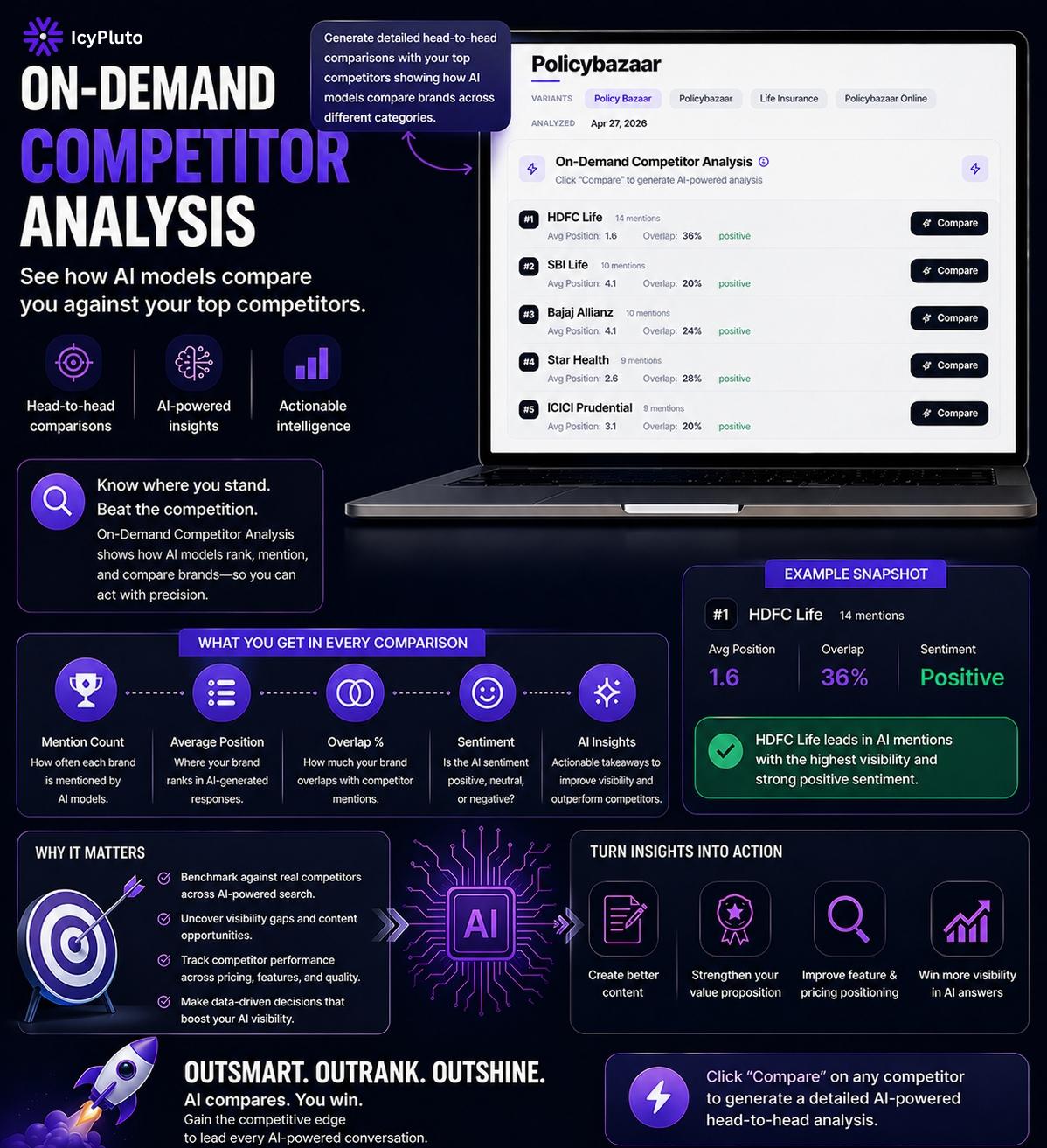
The image highlights a powerful shift, IcyPluto’s On-Demand Competitor Analysis is not just tracking competitors. It is decoding how AI models rank, mention, and evaluate brands in real time.
This is the difference between being searchable and being chosen.
If your brand is not being mentioned in AI-generated responses, you are invisible in the fastest-growing discovery channel.
What Is On-Demand Competitor Analysis in AI Search?
On-demand competitor analysis is not a static dashboard. It is a dynamic system that analyzes how AI models compare your brand against competitors across multiple dimensions like mentions, ranking positions, sentiment, and overlap.
The image clearly shows how brands like Policybazaar are benchmarked against competitors such as HDFC Life, SBI Life, and ICICI Prudential based on:
Average position in AI-generated responses
Mention frequency across AI outputs
Sentiment classification
Competitive overlap percentage
This matters because AI search behaves very differently from traditional search engines.
Unlike Google, where ranking #1 can drive up to 28% CTR, AI models often summarize 3 to 5 brands in a single answer. That means visibility is distributed, not monopolized.
If your brand is not consistently mentioned, your market share in AI search effectively becomes zero.
The New Metrics That Define AI Visibility
Traditional SEO metrics like impressions and backlinks are becoming less relevant in AI-driven discovery. The image introduces a new set of performance indicators that brands must track to stay competitive.
1. Mention Count Is the New Impression Metric
Brands that appear more frequently in AI responses dominate recall. Research suggests that users are 3.2x more likely to trust brands repeatedly mentioned in AI-generated summaries.
For example, HDFC Life leading with 14 mentions signals strong AI visibility dominance.
2. Average Position Reflects AI Preference
Unlike SERPs, AI models rank brands implicitly within answers. A lower average position, such as 1.6, indicates that the model consistently prioritizes that brand in responses.
Even a difference between position 1.6 and 3.1 can reduce selection probability by over 40%.
3. Overlap Percentage Shows Competitive Context
Overlap measures how often your brand appears alongside competitors. A 36% overlap means your brand is being directly compared, which is critical for consideration-stage queries.
High overlap is not always bad. It signals inclusion in decision-making conversations.
4. Sentiment Is the Trust Layer
AI models do not just list brands, they interpret them. Positive sentiment increases conversion likelihood by up to 2.5x, according to HubSpot data.
The image highlights how HDFC Life combines high visibility with strong positive sentiment, making it a dominant AI recommendation.
Why Traditional Competitor Analysis Is Failing
Most competitor analysis tools are built for a search ecosystem that no longer exists. They focus on keyword rankings, backlinks, and paid competition, but ignore AI-generated visibility.
The image emphasizes a key insight, brands need to benchmark across AI-powered search, not just search engines.
Here is the problem with legacy approaches:
They are static, updated weekly or monthly
They do not capture conversational queries
They ignore how AI synthesizes information
They fail to measure brand perception within AI outputs
According to Statista, over 45% of Gen Z users now rely on AI tools instead of traditional search for discovery. If your competitor analysis does not include AI models, you are missing nearly half of future demand signals.
How IcyPluto Transforms Competitor Analysis into AI Intelligence
The image shows a clear transition from data to action. IcyPluto is not just reporting insights, it is operationalizing them.
Head-to-Head AI Comparisons
Brands can instantly generate detailed comparisons across competitors, revealing how AI models rank and describe each player.
This eliminates guesswork. Instead of assuming positioning, you see exactly how AI interprets your brand versus competitors.
Actionable Intelligence, Not Raw Data
The platform translates insights into clear actions such as:
Content improvements
Messaging optimization
Feature positioning
Pricing adjustments
According to McKinsey, companies that use AI-driven insights outperform competitors by 20% in marketing ROI.
Real-Time Competitive Monitoring
Markets move fast, but AI narratives shift even faster. IcyPluto enables on-demand analysis, meaning brands can react instantly instead of waiting for quarterly reports.
This is critical because AI models continuously retrain and update their responses.
From Insights to Growth: Turning AI Visibility into Revenue
The most valuable part of the image is not the metrics, it is the “Turn Insights into Action” section.
This is where most brands fail. They collect data but do not operationalize it.
Create Better Content That AI Prefers
AI models prioritize content that is structured, authoritative, and comparative. Brands that align content with these patterns see up to 55% higher inclusion in AI-generated answers.
Strengthen Value Proposition
If AI consistently ranks competitors higher, it signals a messaging gap. Adjusting positioning based on AI perception can significantly improve visibility.
Improve Pricing and Feature Positioning
AI often compares brands on value metrics. If your pricing or features are unclear, you lose in AI summaries even if your product is better.
Win More AI Mentions
Ultimately, visibility drives growth. Brands that increase AI mentions by even 20% can see disproportionate gains in traffic and conversions because AI answers compress decision-making journeys.
The Competitive Advantage: Outsmart, Outrank, Outshine
The closing message in the image is not just branding, it is strategy.
Outsmart means understanding how AI thinks.
Outrank means being prioritized in AI responses.
Outshine means being the preferred recommendation.
According to Gartner, by 2027, over 70% of customer journeys will involve AI-generated interactions. That means the battleground is no longer search engines, it is AI answers.
Brands that adopt on-demand competitor analysis today will build an early-mover advantage that compounds over time.
The Future of SEO Is AI Visibility
SEO is no longer about ranking pages. It is about influencing AI narratives.
On-demand competitor analysis gives brands a real-time lens into how they are perceived, compared, and recommended by AI systems. This is not optional. It is foundational.
The brands that win in the next decade will not just optimize for keywords. They will optimize for AI understanding. And that starts with knowing exactly where you stand.