
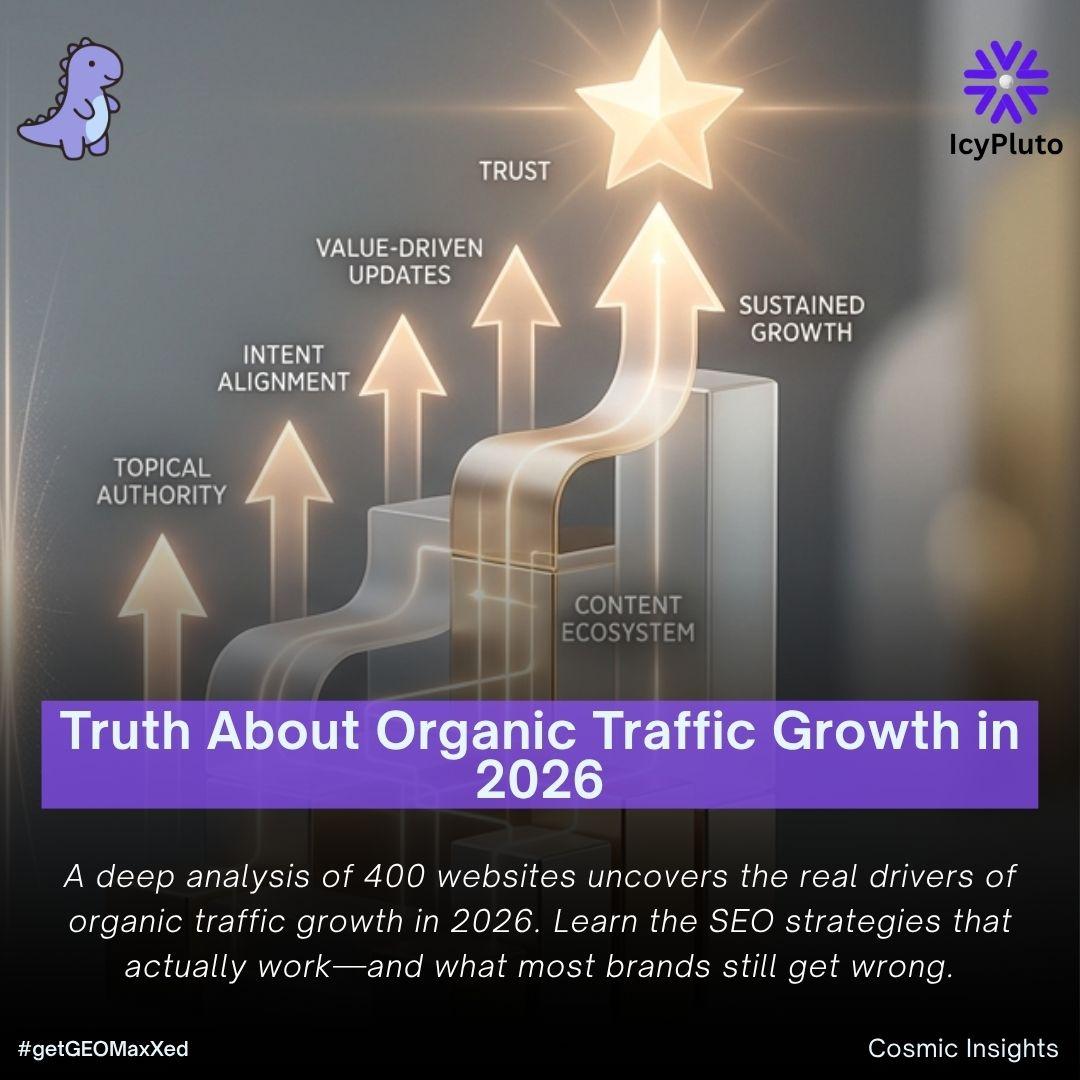
The SEO Illusion: Why Most Traffic Strategies Are Built on False Assumptions
For years, SEO advice has followed a predictable script: publish more content, target more keywords, build more backlinks.
But a recent analysis of 400 websites challenges that narrative entirely.
The findings?
Most websites that grow organic traffic don’t win because they produce more content—they win because they produce better-aligned, intent-driven, and strategically structured content ecosystems.
This is where most SEO strategies break.
Because SEO in 2026 is no longer about volume. It’s about precision, authority, and alignment with search intent at scale.
The Data: What 400 Websites Actually Reveal
The study analyzed hundreds of sites across industries, looking at patterns behind sustained organic growth.
Here are the most important insights:
1. Traffic Growth Is Not Linear—It’s Compounding
One of the biggest revelations:
Organic growth doesn’t happen steadily. It happens in bursts.
Websites often experience:
Long periods of stagnation
Followed by sudden traffic spikes
Then stabilization at a higher baseline
Why this happens:
Google rewards topical authority over time
Content clusters begin to interconnect
Internal linking strengthens relevance signals
Insight:
SEO is less like a faucet and more like a flywheel.
The Rise of Topic Clusters Over Keywords
The data clearly shows that websites focusing on topic ownership outperform those targeting isolated keywords.
What winning sites do differently:
Build content hubs around core themes
Interlink supporting articles strategically
Cover topics deeply instead of broadly
What losing sites still do:
Chase high-volume keywords
Publish disconnected blog posts
Ignore semantic relevance
Non-obvious insight:
Google is no longer ranking pages—it’s ranking topic ecosystems.
Content Velocity vs Content Quality: The Real Trade-Off
Many assume publishing more content leads to more traffic.
The data disagrees.
High-growth sites:
Publish consistently—but not excessively
Prioritize depth, originality, and usefulness
Update existing content frequently
Low-growth sites:
Publish large volumes of low-value content
Rarely refresh outdated pages
Key takeaway:
One high-quality, well-optimized article can outperform 10 mediocre ones.
The Hidden Power of Content Updates
One of the most overlooked growth drivers?
Content refreshes.
The analysis showed that:
Updating old content often drives faster gains than publishing new content
Pages that are refreshed regularly maintain rankings longer
Google rewards freshness when it adds value
What effective updates include:
Adding new data and insights
Improving structure and readability
Aligning with current search intent
Contrarian insight:
SEO isn’t just about creating—it’s about maintaining relevance over time.
Search Intent Alignment: The Real Ranking Factor
Perhaps the most critical finding:
Search intent alignment matters more than backlinks or keyword density.
Winning pages:
Match exactly what users expect
Provide complete, satisfying answers
Reduce the need for further searching
Types of intent high-growth sites dominate:
Informational deep dives
Problem-solving guides
Comparison and decision content
Where most sites fail:
Misunderstanding intent
Writing generic, surface-level content
Ignoring user journey stages
Insight:
Google’s goal is simple: minimize user effort.
Your content must do the same.
Authority Signals Are Evolving
Backlinks still matter—but not in the way most think.
The study suggests:
Fewer, higher-quality links outperform mass link-building
Topical authority reduces reliance on backlinks
Internal linking plays a bigger role than ever
Modern authority signals include:
Topical depth
Content consistency
User engagement signals
Brand credibility
New reality:
You don’t need thousands of backlinks—you need trust within a niche.
Why Most SEO Strategies Fail (Even in 2026)
Let’s be honest—most SEO strategies still fail.
Here’s why:
1. They Focus on Tactics, Not Systems
SEO isn’t about isolated actions.
It’s about building a content system.
2. They Ignore User Experience
Slow sites, poor structure, weak readability = lost rankings.
3. They Chase Trends Instead of Fundamentals
AI content, keyword hacks, quick wins—none replace strategic depth.
4. They Don’t Think Long-Term
SEO success requires:
Patience
Iteration
Compounding effort
The New SEO Growth Framework
Based on the insights from 400 websites, here’s what actually works:
1. Build Topic Authority First
Choose a niche
Create pillar content
Expand with supporting articles
2. Optimize for Intent, Not Just Keywords
Understand what users really want
Structure content accordingly
3. Update Relentlessly
Refresh top pages every 3–6 months
Improve content based on performance data
4. Strengthen Internal Linking
Connect related content
Guide users through journeys
5. Focus on Content Quality
Depth over breadth
Insight over repetition
The Future of Organic Traffic: What Changes Next
Looking ahead, several trends are clear:
AI Will Flood the Internet with Content
Which means:
Average content quality will drop
Truly valuable content will stand out more
Search Will Become More Intent-Driven
Less keyword matching
More contextual understanding
Authority Will Matter More Than Ever
Brands with trust and expertise will dominate
Prediction:
The gap between average and high-performing websites will widen dramatically.
Final Thoughts: SEO Is Becoming a Discipline of Depth
The biggest takeaway from analyzing 400 websites?
SEO success is no longer about doing more—it’s about doing it better.
The winners are not:
The ones publishing the most
The ones building the most links
They are:
The ones building authority
The ones aligning with intent
The ones committing to a gemlong-term strategy
If your SEO strategy still looks like a checklist, it’s already outdated.