
Introduction
For nearly two decades, marketers operated within a familiar framework. Rankings drove clicks, clicks drove traffic, and traffic drove conversions. SEO ROI was relatively straightforward to explain in boardrooms because attribution models were built around search engines that rewarded links and measurable sessions.
That framework is now breaking.
AI-powered search platforms like ChatGPT, Perplexity AI, Google AI Overviews, and Gemini are fundamentally changing how discovery happens online. Users increasingly receive synthesized answers instead of clicking through ten blue links. According to industry reports, zero-click searches already account for more than 60% of Google searches, and AI-generated summaries are accelerating that trend.
This shift created a major challenge for marketing leaders. Companies know they need Answer Engine Optimization, also known as AEO or GEO, but many still cannot answer one critical question:
“How do we prove ROI when the click never happens?”
That is exactly where modern AI visibility strategies separate sophisticated brands from reactive ones.
Traditional SEO ROI Models Are Failing in AI Search
Most analytics frameworks were built for a web where visibility and traffic were tightly connected. In AI search, visibility can influence purchasing decisions long before a user visits your website.
A buyer may ask an AI assistant for the “best enterprise CRM for healthcare,” receive three recommended brands, and make a shortlist decision immediately. Your company may influence the outcome even if no direct click occurs.
This creates what many marketers now call the “dark funnel” of AI discovery.
Traditional SEO metrics like:
Organic clicks
Keyword rankings
Sessions
Backlinks
still matter, but they no longer capture the full picture. AI assistants operate as both retrieval systems and recommendation engines.
That changes attribution entirely.
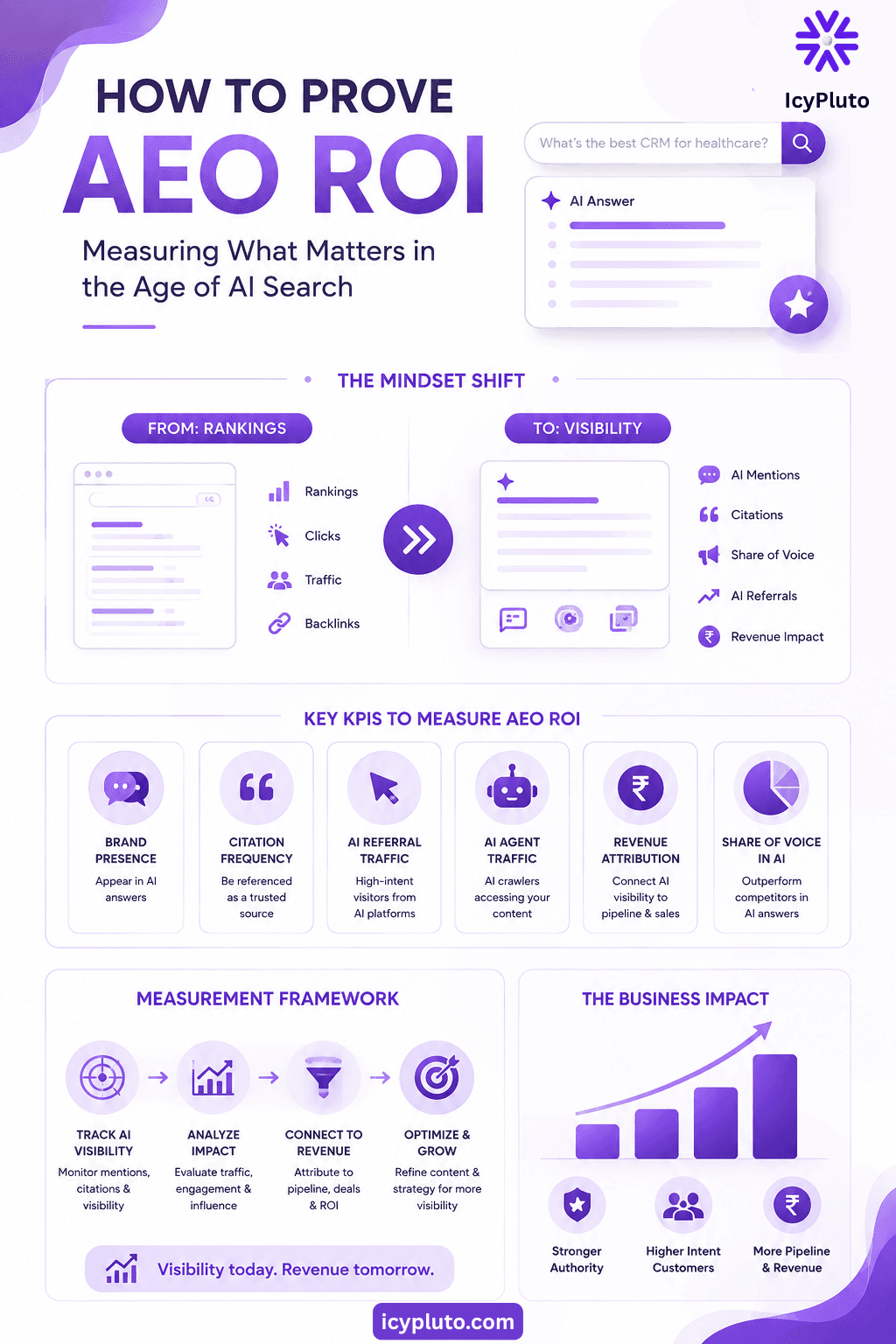
Modern AEO strategies must measure:
Brand mentions inside AI-generated answers
Citation frequency across AI platforms
Prompt visibility
AI referral traffic
Share of voice inside LLM responses
AI agent crawling activity
Revenue from AI-assisted discovery journeys
This is why companies investing heavily in AI search optimization are restructuring their KPI dashboards.
The Rise of AI Visibility as a Business Metric
One of the biggest misconceptions in AEO is that rankings remain the primary objective.
They are not.
Visibility is the new ranking.
In traditional SEO, you competed for a position on a search engine results page. In AI search, you compete to become the answer itself.
That distinction changes optimization priorities dramatically.
Research from AI visibility platforms like Scrunch shows that brands increasingly monitor metrics such as:
Brand presence in AI answers
Citation share across platforms
Prompt positioning
AI referral sessions
AI bot traffic
Competitive AI share of voice
instead of relying solely on organic rankings.
This evolution mirrors what happened with social media years ago. Early marketers struggled to prove the ROI of impressions and engagement because they focused only on direct clicks. Eventually, brands realized visibility itself influenced purchasing behavior.
AI search is now following the same pattern, except the influence is far more transactional.
When an LLM recommends a product, software platform, agency, or service provider, users often interpret that recommendation as authoritative guidance.
That trust compression changes conversion dynamics entirely.
The Most Important KPIs for Measuring AEO ROI
Many organizations fail with AEO because they try to measure AI search using outdated SEO dashboards.
The better approach is building a layered AI visibility framework.
1. Brand Presence Across AI Platforms
This measures how often your brand appears in AI-generated responses for commercially relevant prompts.
For example:
“Best B2B marketing automation software”
“Top cybersecurity firms for enterprises”
“Best AI SEO tools”
Your visibility frequency across these prompts becomes your AI share of voice.
Platforms like ChatGPT and Perplexity AI increasingly shape buying journeys, especially in B2B software and research-heavy industries.
2. Citation Tracking
Citations matter because AI systems prioritize trusted and referenced sources.
If your website is consistently cited in AI-generated answers, it signals authority and retrievability.
Modern AEO tools now track:
Citation frequency
Citation sources
Competitor citations
Citation consistency by topic
This metric is becoming the equivalent of backlinks in AI search ecosystems.
3. AI Referral Traffic
Even though AI search creates more zero-click interactions, referral traffic still matters.
AI referral visitors are often higher intent because they arrive after receiving contextual recommendations.
According to multiple AI search platform analyses, AI-referred traffic frequently converts at higher rates than generic organic traffic because users arrive with stronger purchase intent.
This means lower volume can still generate stronger revenue efficiency.
4. AI Agent Traffic
One of the most overlooked AEO metrics is AI crawler activity.
AI agents continuously visit websites to retrieve, evaluate, and understand content. Monitoring which pages AI agents access reveals how AI systems interpret your website architecture and content hierarchy.
This provides early visibility signals before citations and referral traffic improve.
5. Revenue Attribution
This is where executives ultimately focus.
Can AI visibility influence pipeline and revenue?
The answer increasingly appears to be yes.
Forward-thinking organizations now combine:
AI referral tracking
CRM attribution
Assisted conversions
Self-reported attribution
“How did you hear about us?” forms
to connect AI discovery with business outcomes.
Why Zero-Click Visibility Still Drives Revenue
Many marketers still underestimate how much influence happens before a click.
AI search accelerates pre-click decision-making.
A user asking:
“What’s the best project management software for remote engineering teams?”
may receive a synthesized recommendation list. By the time they visit a website, several brands have already been mentally shortlisted.
This compresses the buyer journey significantly.
In traditional SEO, discovery happened through exploration. In AI search, discovery increasingly happens through recommendation.
That means your brand can lose market share long before analytics tools reveal traffic declines.
This is why AI visibility monitoring has become strategically critical for CMOs.
The brands that appear consistently in AI-generated answers gain:
Trust reinforcement
Perceived authority
Brand familiarity
Higher downstream conversion probability
even when direct attribution remains imperfect.
The Biggest Mistake Companies Make With AEO
Most organizations still treat AEO like a technical SEO checklist.
They focus heavily on:
FAQ schema
metadata
structured markup
semantic formatting
Those elements help, but they are no longer enough.
Multiple AI visibility experts now argue that entity recognition, topical authority, and cross-platform brand repetition matter more than isolated technical tweaks.
In simple terms:
AI systems trust brands they repeatedly encounter across trusted ecosystems.
That means successful AEO requires:
Strong digital PR
Consistent thought leadership
Original research
Expert-driven content
Third-party mentions
Multi-platform authority signals
This is why brands with weaker SEO profiles sometimes outperform larger competitors in AI-generated answers.
AI models optimize for confidence and contextual relevance, not just backlinks.
How CMOs Should Present AEO ROI Internally
One of the smartest approaches to proving AEO ROI is avoiding direct comparisons with traditional SEO metrics.
AEO is not simply “SEO 2.0.”
It is a hybrid visibility layer between:
search
brand marketing
PR
attribution
AI discoverability
CMOs should frame AEO ROI around three business outcomes:
1. Increased AI Share of Voice
Measure how often your brand appears compared to competitors across important commercial prompts.
2. Higher AI-Assisted Pipeline Influence
Track AI-referred sessions, assisted conversions, and self-reported attribution.
3. Reduced Future Discovery Risk
This is the strategic argument many executives overlook.
If AI interfaces become primary discovery environments, brands without visibility inside AI systems may gradually disappear from buying conversations.
That risk alone justifies early investment.
The Future of AEO Measurement
The AI search ecosystem is still immature.
No platform currently provides perfect attribution because many AI interactions happen privately inside conversational interfaces.
But the direction is becoming clear.
The next generation of marketing analytics will likely combine:
AI visibility tracking
Prompt analytics
citation intelligence
conversational attribution
LLM share of voice
AI-assisted revenue modeling
into unified reporting systems.
This is why platforms like HubSpot, Semrush, Scrunch, and emerging AEO startups are rapidly investing in AI visibility analytics.
The companies that establish baselines today will have a major competitive advantage over brands that wait for perfect attribution models.
Because by then, the visibility gap may already be irreversible.