
Introduction
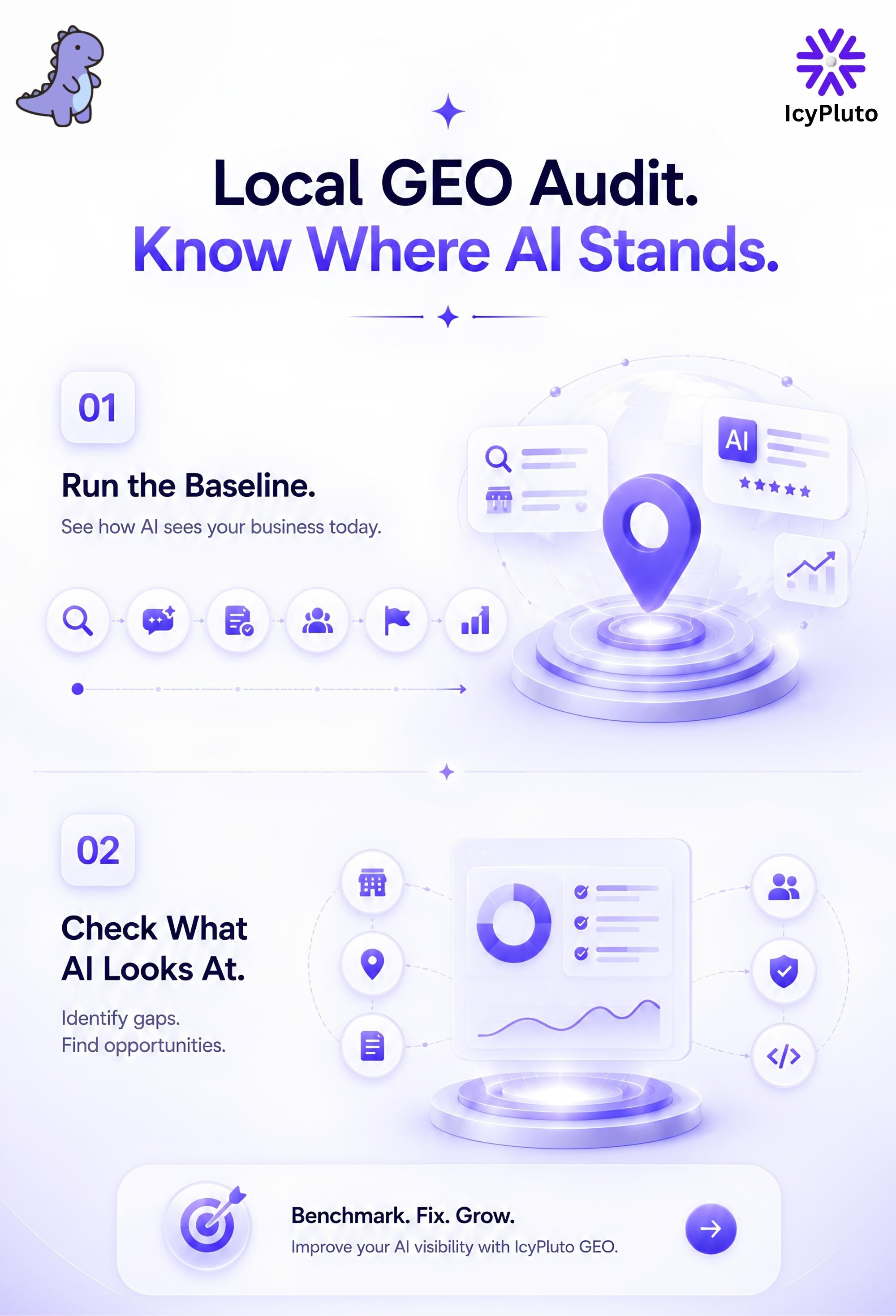
Local visibility is no longer defined only by map packs and blue links. AI tools now shape discovery, recommendations, and comparison behavior, which means a business can lose opportunities even when it still ranks in traditional search. A baseline audit shows where your brand stands today, which competitors appear more often, and what information AI systems are pulling from the web.
That matters because AI answers often depend on structured signals, clear entity data, and consistent business information. If your brand is missing those signals, AI may either skip you or describe you inaccurately. A baseline audit gives you the starting point needed to fix that with confidence.
What A GEO Audit Does
A GEO audit examines how generative engines treat your business across prompts, locations, and intent types. Instead of checking only rankings, it checks whether AI mentions your business, gets the facts right, and prefers competitors. This helps you identify both visibility gaps and trust gaps before you scale your local SEO or GEO work.
The biggest value of a baseline audit is measurement. Once you know your current position, you can re-test after updates and see whether the changes actually improved AI visibility. That makes GEO more practical, more accountable, and easier to report to clients or stakeholders.
Why It Matters
Local businesses are competing in a new discovery layer where AI can answer questions before users ever visit a website. If your business is not visible in those answers, you may lose demand even when your site looks healthy in traditional SEO tools. A GEO baseline audit helps you catch that problem early.
It also helps you avoid wasted effort. Rather than making random content changes, you can focus on the signals that matter most, such as entity consistency, page clarity, and proof of relevance. In short, the audit turns AI visibility into a measurable system instead of a vague idea.
Baseline Audit Steps
A good baseline audit should follow a simple, repeatable process. The goal is to compare what AI says now against what you want it to say later. These steps make that process clearer.
Define the business, service area, and primary intent.
Create a list of prompts users might ask AI tools.
Check whether your business appears in the answers.
Review if the facts are correct, incomplete, or outdated.
Compare your business against direct local competitors.
Record the current visibility level as your baseline.
Re-test after improvements to measure progress.
For IcyPluto users, this step is where the platform’s GEO audit feature fits naturally into the workflow. It can be positioned as the fast way to benchmark AI visibility, uncover gaps, and create an action plan for improvement. That makes the audit phase not just analytical, but operational.
What To Check
A strong GEO baseline audit should consider multiple types of signals. AI systems may pull from your website, your business listings, third-party mentions, and overall entity consistency. If those sources conflict, your visibility can weaken.
Use this checklist during the audit:
Business name, address, and phone number consistency.
Service descriptions across the website and listings.
Local relevance and location signals.
Competitor mentions in AI answers.
Accuracy of facts in AI-generated responses.
Content depth on key service pages.
Structured data and entity clarity.
This is where many local brands discover their biggest issue. The problem is often not a lack of content, but a lack of consistency and clarity across the web. AI systems need enough confidence to recommend to you, and the audit shows where that confidence breaks.
IcyPluto GEO Feature
IcyPluto’s GEO audit feature can be added as the practical step that bridges diagnosis and action. It helps brands move from “Are we visible in AI?” to “What exactly do we need to fix?” That workflow is ideal for local businesses, agencies, and marketing teams that need a clearer starting point.
In the blog, this section can position the feature as a baseline scanner that benchmarks AI visibility, identifies gaps, and gives a repeatable framework for retesting. The platform already presents GEO as an end-to-end visibility loop with measurement, diagnosis, action, and validation. That makes it a strong fit for this topic.
Table: Audit Areas
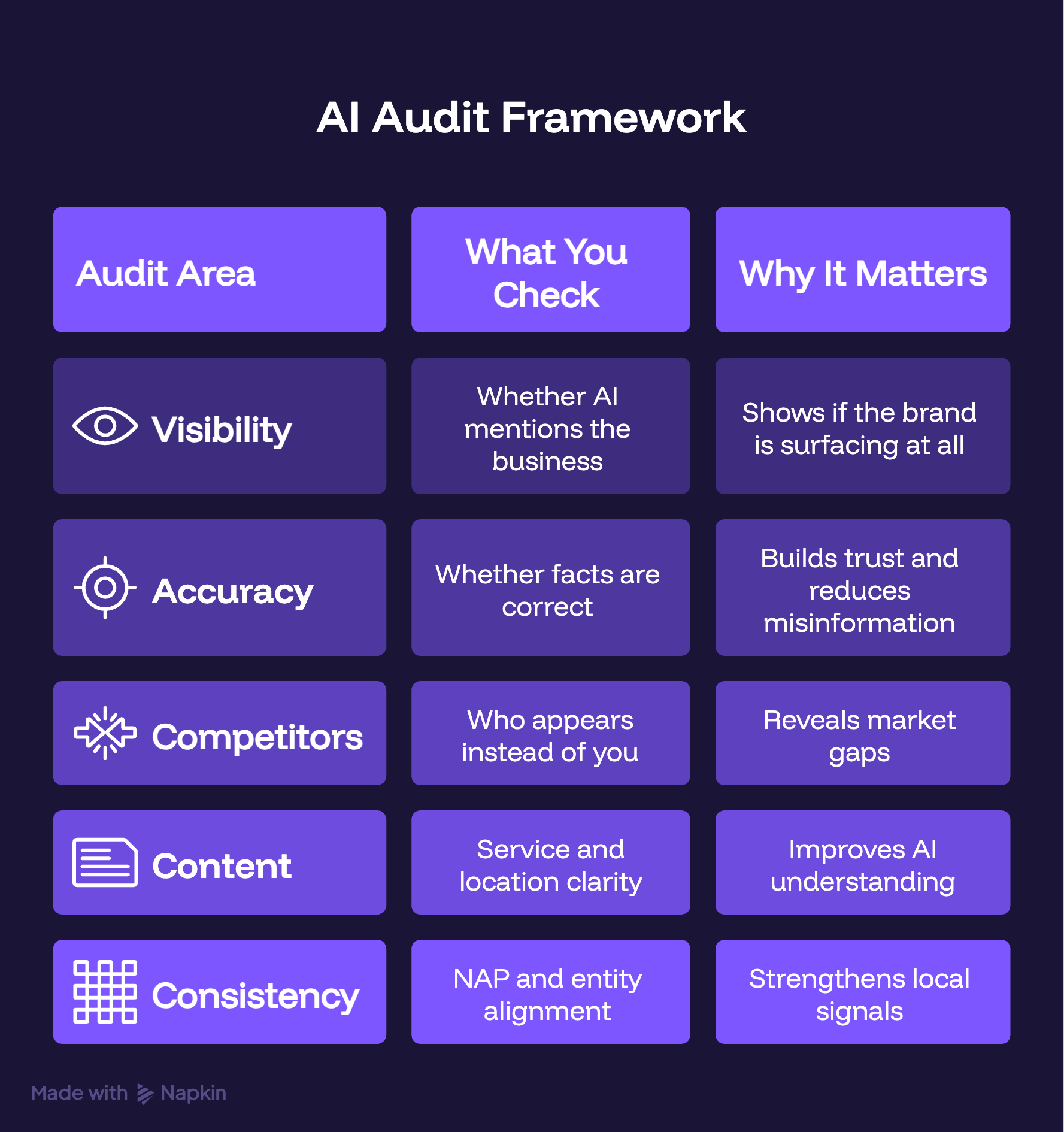
This table makes the audit easier to present to clients or internal teams. It also helps connect the findings directly to next steps, which is important when you want the blog to feel practical and useful.
Conclusion
A local GEO baseline audit is the smartest first step for brands that want better AI visibility. It helps you understand how AI currently sees your business, where competitors are winning, and what signal gaps need to be fixed first. Once you have that baseline, your GEO strategy becomes measurable and much easier to improve.
For IcyPluto, the GEO audit feature should be framed as the tool that makes this process actionable. It gives brands a clear starting point, a repeatable testing method, and a path to stronger generative visibility over time.
Ready to see how AI reads your business today? Explore the IcyPluto GEO demo here: IcyPluto GEO Demo