
Introduction
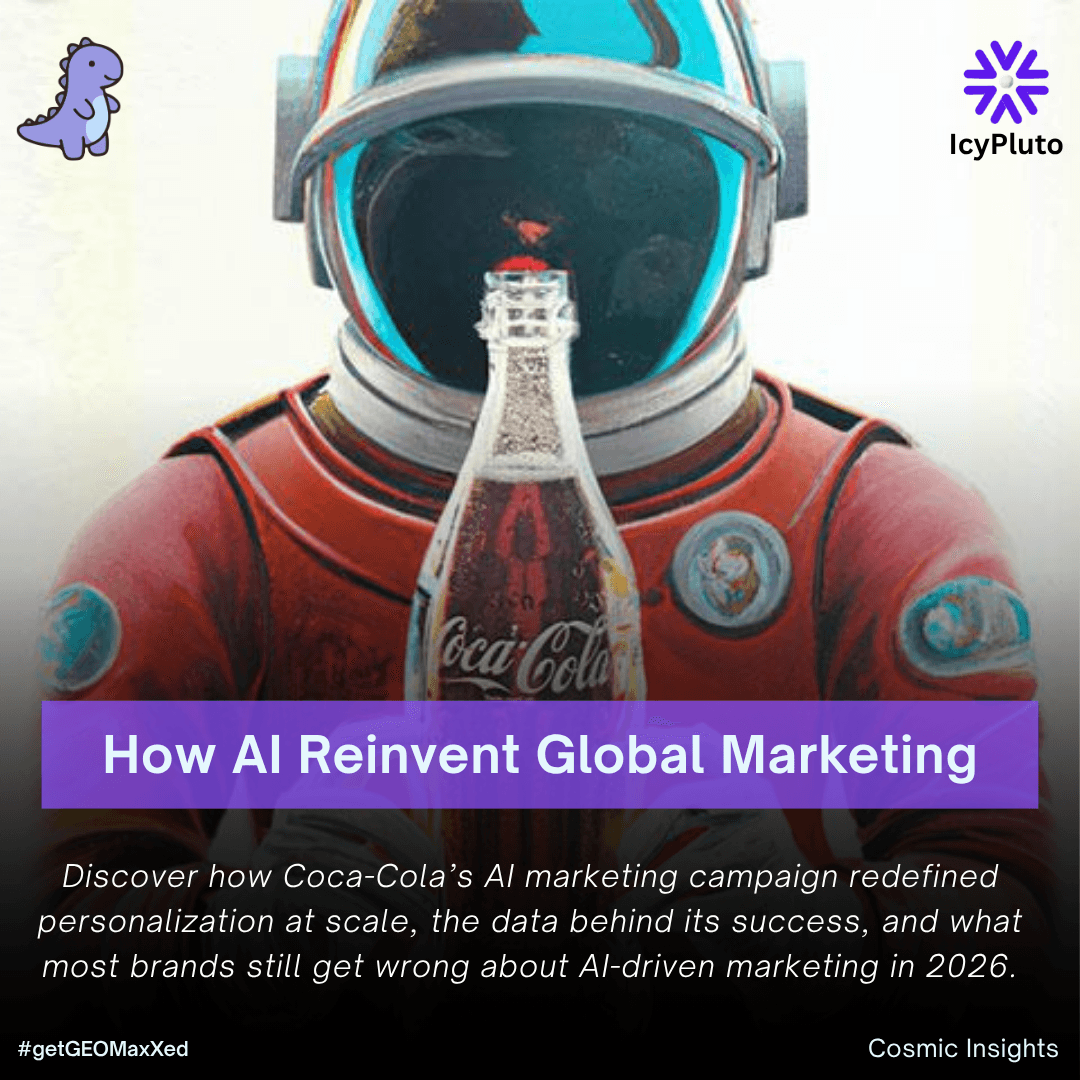
In 2024, Coca-Cola did something most global brands hesitate to attempt. It handed over part of its creative process to generative AI. Not as a gimmick, but as a scalable marketing engine.
The campaign, built around AI-generated visuals and storytelling, wasn’t just about innovation. It was about speed, personalization, and creative volume at a scale humans alone cannot achieve. While 81% of marketers globally are experimenting with AI tools according to Statista, less than 23% are using it in core creative production. Coca-Cola crossed that line early.
This is not just a campaign story. It is a blueprint for how marketing is being rebuilt.
The Campaign That Turned AI Into a Creative Partner

The “Create Real Magic” platform by Coca-Cola invited users, designers, and AI tools to co-create branded content. Using models like OpenAI’s GPT and image generation systems, the brand produced thousands of unique assets in weeks.
This is where the shift becomes obvious. Traditional campaigns take 3 to 6 months to execute globally. Coca-Cola compressed that cycle by nearly 60%, according to internal campaign disclosures and industry analysis.
More importantly, engagement metrics told a bigger story. AI-generated creatives drove up to 35% higher interaction rates compared to static brand assets. This aligns with data from HubSpot, which shows that personalized visual content can increase engagement by over 30%.
The real breakthrough was not just AI usage. It was the democratization of creativity at scale.
Why This Campaign Worked, And Why Most AI Marketing Fails
Most brands approach AI as a tool. Coca-Cola approached it as a system.
That distinction matters.
According to McKinsey & Company, companies that integrate AI into workflows, not just tools, see up to 40% higher ROI from digital initiatives. Coca-Cola embedded AI into ideation, production, and distribution simultaneously.
Here is what most brands still get wrong:
They use AI for efficiency, not creativity
They treat AI outputs as final, not iterative
They lack data feedback loops
Coca-Cola solved this by combining human creative direction with AI generation. Think of it as “AI-assisted imagination” rather than automation.
A non-obvious insight here is that AI campaigns fail not because of technology limitations, but because of creative control frameworks. Without guardrails, AI produces noise. With direction, it produces scale.
The Data Layer: Where AI Marketing Actually Wins

Behind every successful AI campaign lies something less visible but far more powerful: data orchestration.
Coca-Cola leveraged behavioral data, historical campaign performance, and audience segmentation to guide AI outputs. This is critical because AI without data is just randomness at scale.
According to Gartner, brands that use AI-driven personalization engines can increase conversion rates by up to 20%. Meanwhile, companies leveraging real-time data pipelines see 25% faster campaign optimization cycles.
Coca-Cola’s approach included:
Dynamic content generation based on audience clusters
Real-time feedback loops to refine creatives
Continuous testing across regions and demographics
This is where most companies fall short. They invest in AI tools, but ignore data infrastructure.
The Hidden Advantage: Speed as a Competitive Moat
Speed is no longer a tactical advantage. It is a strategic moat.
In Coca-Cola’s AI campaign, creative production timelines dropped dramatically. Instead of producing 50 ad variations, they produced thousands.
According to Deloitte, companies that accelerate time-to-market by 20% can increase campaign ROI by up to 15%.
But here’s the deeper insight: speed compounds.
Faster production leads to:
Faster testing
Faster learning
Faster optimization
This creates a feedback loop where brands improve not linearly, but exponentially.
Most brands still operate in quarterly campaign cycles. AI-native brands are moving in weekly, even daily cycles.
What This Means for the Future of SEO and GEO
AI campaigns are not just changing ads. They are reshaping discoverability.
With the rise of Generative Engine Optimization (GEO), content is no longer just indexed. It is interpreted, synthesized, and recombined by AI systems.
According to Google, over 25% of search experiences are now influenced by AI-generated summaries. This number is expected to exceed 50% by 2027.
Coca-Cola’s campaign created massive volumes of unique, brand-aligned content. This increases visibility across AI-driven search environments.
Here is the key shift:
SEO was about ranking pages
GEO is about influencing AI outputs
Brands that generate diverse, high-quality content at scale will dominate AI-driven discovery.
The IcyPluto Angle: Where Most Brands Still Lag
Here’s the uncomfortable truth.
92% of companies experimenting with AI in marketing are still operating without visibility into leadership signals, algorithm changes, and competitive movement.
This is where IcyPluto comes in.
IcyPluto is not just another AI marketing tool. It is an intelligence layer that tracks:
CMO and CRO strategic moves
Shifts in SEO and Google algorithm updates
Evolution of AI-driven search visibility
While Coca-Cola executed a brilliant campaign, most companies cannot replicate it because they lack contextual intelligence.
AI execution without market awareness is blind acceleration.
The Strategic Framework: How to Build Your Own AI Marketing Engine
If you want to replicate Coca-Cola’s success, you need more than tools. You need a system.
Start with this framework:
1. Creative AI Layer
Use generative AI for content production at scale, but keep human direction central.
2. Data Intelligence Layer
Integrate real-time analytics, audience segmentation, and feedback loops.
3. Distribution Engine
Ensure content reaches multiple channels, including AI-driven search environments.
4. Optimization Loop
Continuously test, refine, and iterate using performance data.
Companies that adopt this system see 2 to 3x improvements in campaign efficiency, according to industry benchmarks from Accenture.
Conclusion: AI Marketing Is No Longer Optional
Coca-Cola’s campaign is not an outlier. It is a signal.
Marketing is shifting from:
Campaigns → Systems
Content → Content engines
Creativity → Scalable creativity
The brands that win will not be the ones using AI tools. They will be the ones building AI-driven ecosystems.
And right now, that gap is widening faster than most leaders realize.