
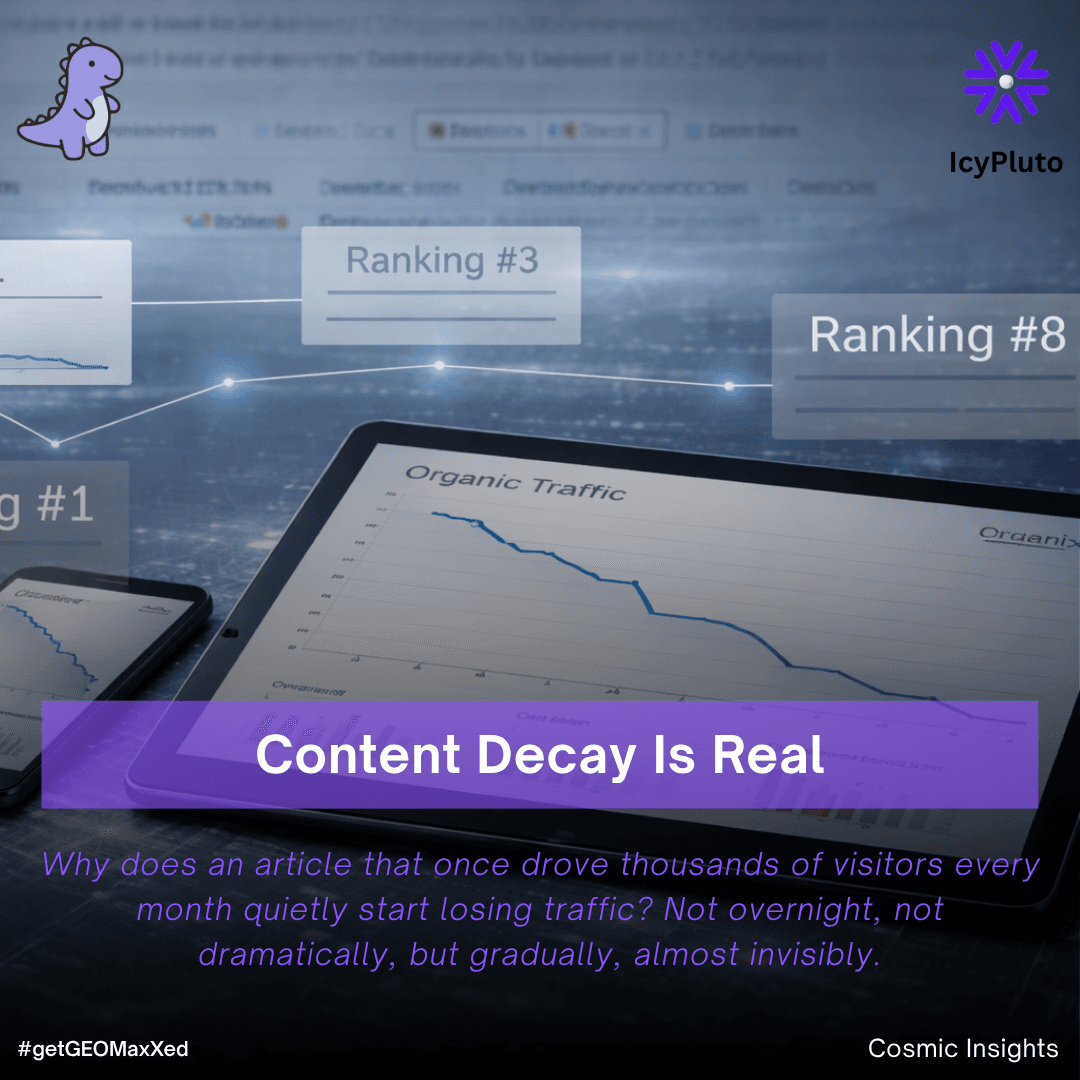
Every Piece of Content You Publish Has an Expiry Date
Every piece of content you’ve ever created is slowly losing its value. That might sound a bit extreme, but it’s the reality of how the internet works.
Content is not static. It lives in an environment that is constantly evolving, as search algorithms change, competitors improve their content, user behavior shifts, and new formats emerge. What worked exceptionally well a year ago may already be underperforming today.
An article that once drove thousands of visitors every month can quietly start losing traffic. Not overnight, not dramatically — but gradually, almost invisibly.
This phenomenon is known as content decay.
And if you are not actively monitoring it, chances are it is already happening across your website.
What is Content Decay?
Content decay refers to the gradual decline in a page’s organic traffic and search rankings over time.
Unlike sudden drops caused by algorithm updates or penalties, content decay is subtle. It happens slowly, often over months or even years, making it easy to ignore until performance has significantly dropped.
You don’t wake up one day to a massive crash. Instead, traffic starts slipping little by little — until one day you realize that a once top-performing page is no longer delivering results.
That’s what makes content decay dangerous. It is silent, consistent, and often overlooked.
The Lifecycle of Content
To understand content decay, it helps to look at content as something that follows a lifecycle.
Most pieces of content go through similar stages:
1. Early Traction
When you first publish content, it gets indexed by search engines. It may start ranking for a few keywords and gain some initial visibility. Traffic is low but promising.
2. Growth Phase
As the content gains backlinks, engagement, and authority, rankings improve. Traffic begins to grow steadily, and the page starts attracting a consistent audience.
3. Peak Performance
This is the golden stage. Your content ranks for its target keywords, drives strong organic traffic, and performs at its highest level.
4. Plateau
At this stage, performance appears stable. Traffic doesn’t drop immediately, but behind the scenes, rankings begin to slip. Competitors start catching up.
5. Decline
Eventually, fresher or better-optimized content overtakes yours. Rankings fall, visibility drops, and traffic declines.
The biggest mistake most teams make is focusing heavily on the first three stages: creation, growth, and peak, while completely ignoring the last two.
But in reality, the decline phase is where long-term growth is either protected or lost.
Content Decay is No Longer One-Dimensional
Earlier, content decay was primarily about losing rankings on search engines like Google.
Today, the situation is more complex.
We are now operating in a dual-visibility environment:
Traditional search engines (Google, Bing)
AI-driven platforms (ChatGPT, Google AI Overviews, Gemini, etc.)
This means your content can:
Still ranks on Google
But it completely disappears from AI-generated answers
And this is critical. Because users are increasingly relying on AI-generated responses to make decisions. So even if your content is technically “ranking,” it may not be visible where it matters most.
Why Content Decay Happens
Content decay rarely has a single cause. It usually happens due to a combination of factors.
1. Content Freshness
Search engines prioritize updated content, especially for topics that evolve quickly.
If your article hasn’t been updated in years, it is automatically at a disadvantage even if it is well-written and comprehensive. Google’s systems, particularly those focused on freshness, favor content that reflects current information.
AI systems take this even further.
They tend to prioritize:
Recently updated content
Content with current data
Content that reflects the latest context
In simple terms:
Old content is competing with newer, more relevant information and often losing.
2. Competitor Improvement
The internet is competitive. Even if your content is strong, someone else may publish something better.
Competitors might:
Add more depth
Include updated data
Match search intent more accurately
Earn more backlinks
And over time, their content gradually pushes yours down. This is one of the most common causes of content decay and also one of the hardest to detect because it happens slowly.
3. Search Intent Shift
Search intent is not fixed.
What users expect from a keyword can change over time.
For example:
A keyword that once required informational content may now demand actionable guides
A topic that was once academic may now be practical
A term may even change meaning entirely
If your content does not evolve with user intent, it becomes less relevant — even if the keyword remains the same.
4. Keyword Cannibalization
Sometimes, the problem comes from within your own website. When multiple pages target the same or similar keywords, they compete against each other. Instead of building one strong page, you end up with multiple weaker ones.
This splits authority, confuses search engines, and leads to declining performance across all pages involved.
The Hidden Cost of Ignoring Content Decay
Content decay is not just about losing traffic.
It affects:
Lead generation
Brand visibility
Authority in your niche
Overall marketing ROI
You may continue producing new content while older content quietly underperforms, creating a false sense of growth.
But in reality, you are leaking traffic from existing assets.
The Shift from SEO to AI Visibility
The biggest change today is not just content decay — it’s where visibility is happening.
Search is no longer limited to:
Ranking pages
Clicking links
It is now about:
AI-generated answers
Summarized insights
Direct responses
This creates a new challenge.
Your content must not only:
Rank on search engines
But also:
Be selected by AI systems
Be cited in responses
Be trusted as a source
This is where traditional SEO alone is no longer enough.
The New Standard: Content That Stays Relevant
To survive content decay, content must evolve continuously.
It needs to be:
Updated regularly
Aligned with current search intent
Structured for both humans and AI
Backed by accurate and recent data
Most importantly, it needs to deliver real value.
Because both search engines and AI systems are increasingly prioritizing:
Expertise
Clarity
Authority
Trustworthiness
The Reality Every Marketer Needs to Accept
Content does not stay relevant forever.
It either:
Gets updated
Gets replaced
Or gets ignored
There is no middle ground.
The brands that win are not just the ones creating content; they are the ones maintaining, evolving, and optimizing it over time.
Final Thought
Content decay is inevitable.
The question is not whether it will happen; It’s how early you detect it and how effectively you respond.
Because the difference between:
Losing 20% of your traffic
And losing 80%
Often comes down to one thing: Whether you paid attention early enough.