
The digital world never stands still, but every once in a while, big shifts come along that force all of us to pause and seriously reconsider how we operate. Google’s recent events — I/O and Marketing Live — delivered exactly that kind of moment. What emerged wasn’t just a collection of new features. It was a clear vision of how search, advertising, shopping, and discovery are evolving around artificial intelligence in deeper, more transformative ways.
At Icypluto, we’ve been closely following these developments because they affect every business trying to stay visible and relevant online. The message is loud and clear: the old rules of marketing are changing faster than many expected. Those who adapt thoughtfully will find new opportunities, while those who cling to outdated playbooks may struggle.
Let’s break down what’s really happening and what it means for all of us moving forward.
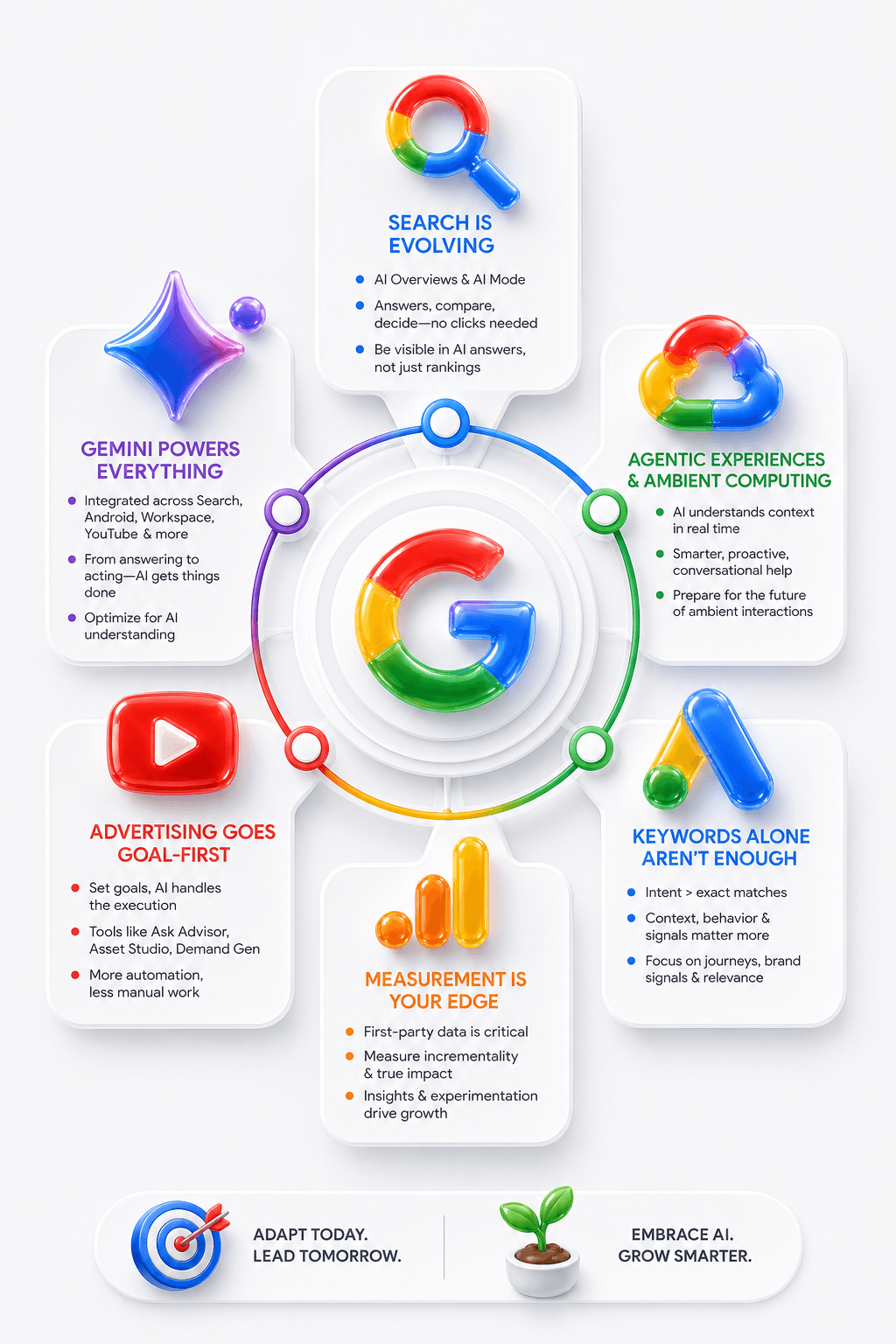
Search Is No Longer Just About Links
For decades, Google Search worked in a fairly predictable way. You typed something, got a list of blue links, and clicked through to find your answers. That model is rapidly fading into the background.
Google is turning Search into something much more conversational and decision-oriented. With expanded AI Overviews and the new AI Mode, users can now get curated summaries, compare options, ask follow-up questions, and even complete parts of their journey without ever leaving the search experience.
Imagine searching for “best CRM for small teams” and instead of just links, you receive a thoughtful comparison, pros and cons, pricing insights, and recommendations — all generated and organized by AI. You might finish your research and make a decision right there.
This shift changes everything for content creators and businesses. Traditional organic traffic that relied on clicks is likely to decrease in many cases. Visibility inside AI-generated answers is becoming just as important — sometimes more important — than ranking in the classic ten blue links.
The implications run deep. Marketers can no longer focus solely on driving clicks. They need to think about how their brand and information appear when AI is summarizing options for users.
Gemini Is Becoming the Brain Behind Everything
One of the strongest themes this year was Google’s push to make Gemini its central intelligence layer. It’s no longer positioned as just another chatbot. Instead, it’s being integrated across Search, Android, Workspace, YouTube, shopping, and even future hardware.
This move signals a bigger ambition: creating agent-like experiences where AI doesn’t just answer questions but actively helps complete tasks. Researching options, organizing information, making recommendations, and guiding users through decisions — all powered by more sophisticated AI.
We’re moving from a world where users browse manually to one where AI can browse and filter on their behalf. That’s a profound change in how people will discover and interact with brands.
For businesses, this means your content and brand signals need to be clear, trustworthy, and structured in ways that AI systems can easily understand and surface. It’s no longer enough to optimize for humans alone. You also need to be optimized for AI interpretation.
The Rise of Agentic Experiences and Ambient Computing
Google also showed continued investment in hardware directions like intelligent eyewear and Android XR. While smart glasses have had mixed success in the past, the addition of powerful AI changes the equation.
The vision is ambient computing — AI that understands context in real time, sees what you see, hears what you hear, and offers helpful suggestions without being asked. Live translation, instant recommendations, contextual shopping guidance — these could become everyday realities.
This future points toward more spoken, proactive, and situational interactions. Websites and traditional apps might become less central as interfaces evolve. Businesses that prepare for these conversational and contextual experiences will have an edge.
Advertising Is Shifting to a Goal-First, AI-Executes Model
On the advertising side, the changes are equally significant. Google is doubling down on automation. Marketers are encouraged to set clear business goals — more leads, more revenue, better customer acquisition — and let AI handle much of the heavy lifting around execution.
Tools like Ask Advisor, Asset Studio, and enhanced Demand Gen features are making it easier to plan campaigns conversationally and generate creative variations quickly. The platform is taking on more responsibility for optimization across channels.
This is both exciting and challenging. On one hand, it can improve efficiency. On the other, it reduces direct control and transparency. Success will depend more than ever on having clean first-party data, strong creative assets, and clear strategic direction.
Why Keywords Alone Are No Longer Enough
Traditional keyword-focused marketing is losing some of its power. Google’s systems are getting much better at understanding intent through context, behavior, conversational patterns, and broader signals rather than exact word matches.
This doesn’t mean keywords are dead, but they are becoming part of a larger intelligence system. Marketers need to think more holistically about user journeys, brand signals, and how AI interprets overall relevance and authority.
Measurement Is Now a True Competitive Advantage
As automation takes over more execution, high-quality measurement becomes crucial. The best-performing teams will be those with strong first-party data, clear conversion tracking, and the ability to measure true incrementality.
Google is pushing marketers to spend less time on manual reporting and more time on strategic insights and experimentation. Those who master this shift will guide AI systems more effectively toward real business outcomes.
YouTube’s Expanding Role
YouTube is being positioned as more than just an awareness channel. With better integration across the funnel, creator partnerships, and AI-assisted planning, it’s becoming a powerful platform for both brand building and performance marketing.
In a world where search is more conversational, YouTube’s ability to build familiarity and trust becomes even more valuable. Smart marketers will look for ways to connect their Search and YouTube strategies more seamlessly.
The Growing Importance of Conversational Commerce
Shopping experiences are also becoming more conversational. AI can now help narrow options, explain differences, incorporate reviews, and guide purchases within the same interaction. This shortens traditional customer journeys significantly.
Brands that invest in clear trust signals — authentic reviews, authoritative content, consistent expertise — will have a major advantage in these AI-mediated buying experiences.
Brand Authority May Matter More Than Ever
Perhaps the most important takeaway is this: in an AI-curated world, brand authority becomes one of the strongest competitive advantages.
When AI systems recommend options and summarize information, they favor brands that are recognized as credible, trustworthy, and authoritative. Strong brands get mentioned more, cited more, and trusted more.
This means businesses should focus on long-term brand building alongside performance marketing. Creating genuinely helpful content, earning positive reviews, building consistent expertise, and maintaining high standards all contribute to how AI perceives and presents your brand.
What This Means for Different Types of Businesses
For small and medium businesses, these changes create both challenges and opportunities. While competing on sheer volume becomes harder, focusing on niche authority and direct relationships can provide protection against AI shifts.
Larger enterprises have more resources to invest in data infrastructure and brand campaigns, but they must avoid becoming too reliant on automation without strategic oversight.
Agencies and consultants will need to evolve their services toward strategy, measurement, and brand development rather than purely tactical execution.
Practical Steps You Can Take Today
Here are some actionable ways to prepare for this new landscape:
Audit your content for depth, originality, and helpfulness. Focus on topics where you can genuinely stand out.
Strengthen your first-party data collection through better website experiences, email lists, and customer interactions.
Invest in brand-building activities that enhance trust and authority signals.
Experiment with conversational content formats that align with how people now interact with AI.
Build measurement frameworks that go beyond surface metrics to true business impact.
Start testing AI tools internally to understand how they summarize and recommend in your category.
Icypluto POV
At Icypluto, we believe these changes reinforce something we’ve been saying for a while: the future belongs to brands that prioritize real value and authentic connections. We’re already adjusting our strategies to focus more on creating content that serves both humans and AI systems well.
We see AI as a powerful assistant, not a replacement for thoughtful strategy. Our approach emphasizes quality, authority, and direct audience relationships. These Google announcements only strengthen our conviction that building a resilient, trusted brand is one of the smartest investments any business can make right now.
Looking Ahead With Optimism
The changes Google outlined aren’t about destroying old opportunities — they’re about creating new ones for those willing to adapt. Marketing is becoming more strategic, more human-centered in its goals, and more sophisticated in execution.
While the tools and interfaces will continue evolving, the fundamentals remain: understand your audience deeply, deliver genuine value, build trust consistently, and measure what truly matters.
The businesses that thrive won’t necessarily be the ones that master every new AI feature first. They’ll be the ones that stay focused on creating experiences and information that people — and the AI systems guiding them — find genuinely useful and trustworthy.
The next few years will be transformative. By embracing these shifts thoughtfully, we can build stronger, more sustainable ways to connect with customers in an increasingly AI-mediated world.